


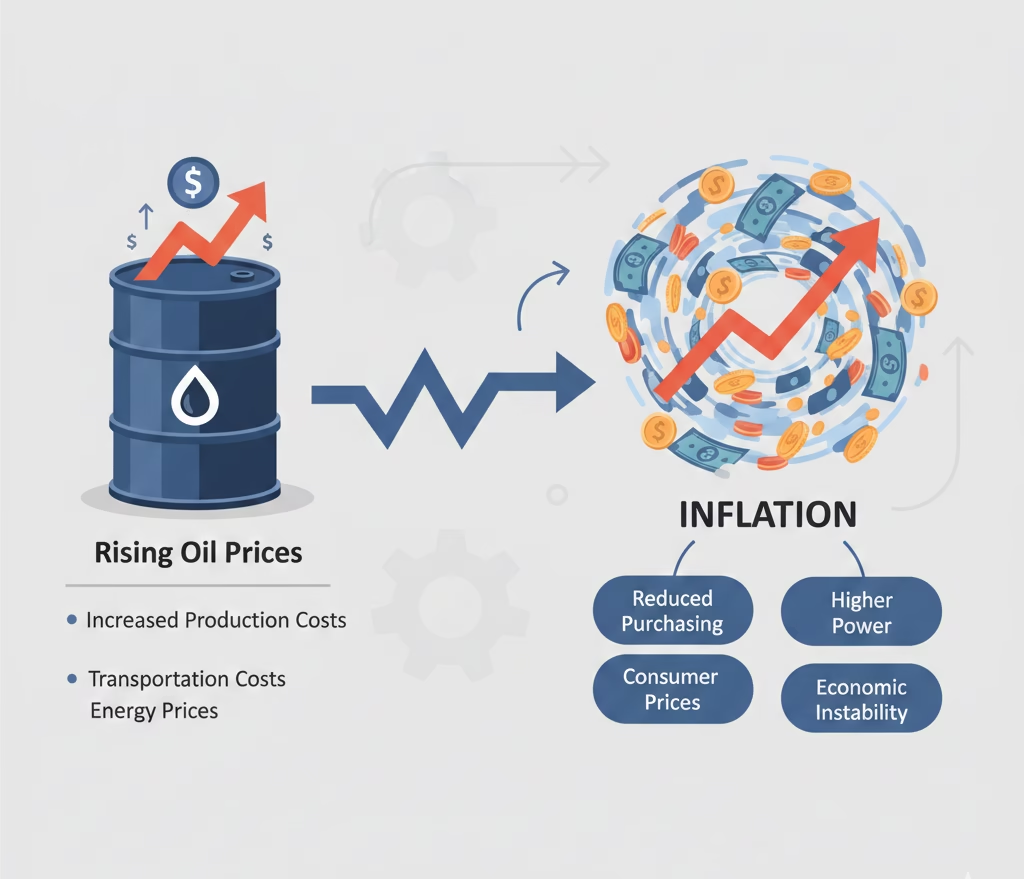
The Relationship Between Oil Prices and Inflation
Oil prices and inflation have long been linked in economic discussions. For decades, sharp moves in crude oil prices were often followed by noticeable changes in inflation. However, this relationship has evolved significantly over time. While oil remains a critical input for the global economy, its ability to drive overall inflation is no longer as powerful or predictable as it once was.
This article explains how oil prices influence inflation, why the relationship was stronger in the past, what has changed since the 1970s, and how oil prices affect consumer prices, producer prices, and economic growth today.
What Is the Relationship Between Oil Prices and Inflation?
Oil prices influence inflation through a cause-and-effect relationship. When oil prices rise, inflation tends to increase because oil is deeply embedded in the production and transportation of goods and services across the economy.
Inflation measures the overall rate at which prices increase. In the United States, it is commonly tracked through indicators such as the Consumer Price Index (CPI), Producer Price Index (PPI), and Personal Consumption Expenditures (PCE) Price Index.
Historically, rising oil prices contributed significantly to inflation. Today, the connection still exists, but it is weaker, more complex, and less automatic.
Why Oil Is So Important to the Economy
Crude oil is not just a fuel. It is a foundational economic input used in:
- Transportation (cars, trucks, ships, planes)
- Manufacturing
- Electricity generation in some regions
- Petrochemicals used to make plastics, fertilizers, and synthetic materials
- Heating and industrial processes
Because oil touches so many parts of the economy, changes in its price ripple outward, affecting costs for businesses and households alike.
How Rising Oil Prices Contribute to Inflation
1. Direct Impact on Energy Prices
When oil prices rise, consumers often feel it first at the gas station. Energy prices are a direct component of inflation indexes like the CPI.
In the U.S., energy accounts for roughly 7% of the CPI, and energy commodities such as gasoline make up about 4%. Since crude oil represents roughly half the retail price of gasoline, changes in oil prices can quickly push fuel costs higher.
2. Higher Transportation Costs
Oil fuels the transportation system. When fuel prices increase:
- Shipping goods becomes more expensive
- Airlines raise ticket prices
- Delivery and logistics costs rise
These costs are often passed on to consumers in the form of higher prices for everyday goods.
3. Rising Input Costs for Businesses
Crude oil is a key ingredient in petrochemicals used to make plastics, packaging, synthetic fibers, and industrial materials. As oil prices rise:
- Manufacturing costs increase
- Packaging becomes more expensive
- Construction materials see price pressure
Businesses may absorb these costs initially, but persistent increases often lead to higher consumer prices.
4. Indirect Effects on Core Inflation
Core inflation excludes food and energy because they are volatile. However, oil still affects core inflation indirectly through higher production and transportation costs embedded in non-energy goods and services.
Oil Prices and Inflation: What History Tells Us
The Strong Link in the 1970s
The relationship between oil prices and inflation was strongest during the 1970s and early 1980s. Two major oil shocks, the OPEC embargo in 1973 and the Iranian Revolution in 1979, sent oil prices soaring.
At the time:
- The U.S. economy consumed more than one barrel of oil per $1,000 of GDP
- Manufacturing played a larger role
- Energy efficiency was low
The result was stagflation– high inflation combined with slow economic growth and rising unemployment.
By 1980, U.S. inflation had more than doubled, cementing oil’s reputation as a primary inflation driver.
Why the Oil–Inflation Link Has Weakened
1. Lower Oil Intensity of the Economy
The U.S. economy now uses far less oil per unit of output. By 2019, oil consumption had fallen to about 0.4 barrels per $1,000 of GDP, a dramatic decline from the 1970s.
Improved energy efficiency, technological advances, and structural changes have reduced oil’s inflationary power.
2. Growth of the Service Sector
Today’s economy is dominated by services rather than manufacturing. Services such as healthcare, education, finance, and technology rely less directly on oil.
Because services make up a larger share of consumer spending, oil price changes have a smaller impact on overall inflation.
3. Better Monetary Policy
Central banks now respond more aggressively and credibly to inflation risks. Since the 1990s, improved inflation targeting and interest rate policy have helped prevent oil price spikes from turning into long-lasting inflation.
4. Globalized and Competitive Markets
Global competition and supply chain efficiency have made it harder for companies to pass higher costs directly to consumers, especially for non-essential goods.
Oil Prices and Inflation in the 2000s and Beyond
Several major oil price increases since the 1990s had limited inflation impact:
- The 1991 Gulf War oil spike barely moved CPI
- Oil prices tripled between 1999 and 2005 with minimal inflation impact
- Economic growth remained strong despite higher crude prices
These episodes demonstrated that oil price increases no longer automatically translate into high inflation.
The Inflation Spike of 2022: A Special Case
In March 2022, U.S. inflation reached a 40-year high, driven by:
- COVID-19 supply chain disruptions
- Strong post-pandemic demand
- Labor shortages
- Expansionary fiscal and monetary policy
- Russia’s invasion of Ukraine
Oil prices rose sharply as sanctions restricted Russian supply. While higher oil prices added to inflation, they were not the sole or primary cause.
Federal Reserve Chair Jerome Powell estimated that every $10 increase in oil prices raises inflation by about 0.2% and reduces economic growth by 0.1%, suggesting oil played a supporting, not dominant, role.
Producer Prices vs Consumer Prices: Where Oil Matters Most
Producer Price Index (PPI)
The PPI measures prices at the wholesale level. Oil prices have historically had a much stronger influence on PPI than CPI.
- Correlation between oil prices and PPI (1970–2017): 0.71
- Reflects oil’s importance in manufacturing and industrial inputs
Consumer Price Index (CPI)
The CPI tracks what consumers pay for goods and services.
- Correlation with oil prices: 0.27
- Services-heavy consumption basket reduces oil’s impact
This explains why oil shocks tend to show up more clearly in producer prices than in consumer inflation.
Oil Prices and Inflation Expectations
While oil may not drive inflation directly, it still influences inflation expectations. Rising oil prices often signal higher costs and economic pressure, which can affect how businesses and consumers plan for future prices.
Markets continue to watch oil closely as a barometer of future inflation risks.
Does Inflation Push Oil Prices Higher?
The relationship works both ways.
Short Term
Higher inflation often coincides with:
- Strong economic growth
- Rising demand for energy
- Higher oil prices
Long Term
If inflation forces central banks to raise interest rates:
- Economic growth may slow
- Energy demand can weaken
- Oil prices may decline
This explains why oil prices sometimes rise early in inflation cycles and fall later.
Interest Rates, the Fed, and Oil Prices
Historically, oil prices have not consistently fallen after interest rate hikes. In several rate-hike cycles, oil prices actually rose in the months following the first increase.
This shows that:
- Oil prices are driven more by supply, demand, and geopolitics
- Monetary policy is only one of many influences
The Role of Geopolitics and Supply Shocks
Oil prices remain highly sensitive to:
- Wars and sanctions
- OPEC+ production decisions
- Supply disruptions
- Trade tensions
Recent examples include:
- Russia–Ukraine conflict
- OPEC+ production changes
- U.S.–China trade uncertainty
These factors can move oil prices independently of inflation trends.
Renewable Energy and the Future Inflation Link
Some analysts argue that the shift toward renewable energy could re-strengthen the link between energy costs and inflation.
Reasons include:
- High upfront investment costs
- Expensive grid upgrades
- Reduced efficiency during transition periods
- Less global energy arbitrage
At the same time, renewables reduce long-term exposure to fossil fuel price shocks, making the net effect uncertain.
Oil Prices in 2025: A Changing Dynamic
In early 2025, oil prices fell sharply due to:
- Soft global demand
- Trade tensions
- Increased OPEC+ output
Despite the decline, inflation remained relatively stable, reinforcing the idea that oil is no longer the main inflation driver.
Forecasts suggest moderate oil prices through 2026, with limited inflation impact unless supply shocks re-emerge.
Key Takeaways
- Higher oil prices still contribute to inflation, but the effect is smaller than in the past
- Oil has a stronger impact on producer prices than consumer prices
- The service-based economy has reduced oil’s inflationary power
- Inflation today is driven more by labor costs, supply chains, and monetary policy
- Oil remains an important signal, but not a dominant force, in inflation dynamics
The Bottom Line
Oil prices and inflation are still connected, but the relationship is no longer simple or automatic. While oil remains a critical input for manufacturing and transportation, structural changes in the economy have weakened its ability to drive broad-based inflation.
In today’s economy, oil prices matter, but they are just one piece of a much larger inflation puzzle shaped by policy decisions, global supply chains, labor markets, and geopolitical events.
For investors, policymakers, and consumers alike, understanding this evolving relationship is essential for interpreting economic trends in a more nuanced way.
Other topics you might be interested in:
What Is Inflation? Meaning, Causes and How It Affects Consumers
What Is Consumer Price Index (CPI)? Meaning, Calculation, and Why It Matters
Gross Domestic Product (GDP): Meaning, Formula, Types & Importance
Recession: Definition, Causes, Examples, and How It Affects You
Bond Yield Explained: What It Is, Why It Matters, and How to Calculate It