


This article explains what happened, why the US attacks Venezuela, and how this could reshape the economies of both countries—and potentially affect global markets.
In the early hours of 3 January 2026, the world woke up to a dramatic and unprecedented development in global geopolitics: the United States launched a large-scale military operation against Venezuela, an action that resulted in the capture of the country’s sitting president, Nicolás Maduro.
The operation, officially named Operation Absolute Resolve, marked one of the most aggressive U.S. interventions in Latin America in decades. More importantly for investors, energy markets, and emerging economies, the event has introduced deep uncertainty into global oil supply chains, regional trade, and international law.
What Happened When the US Attacked Venezuela
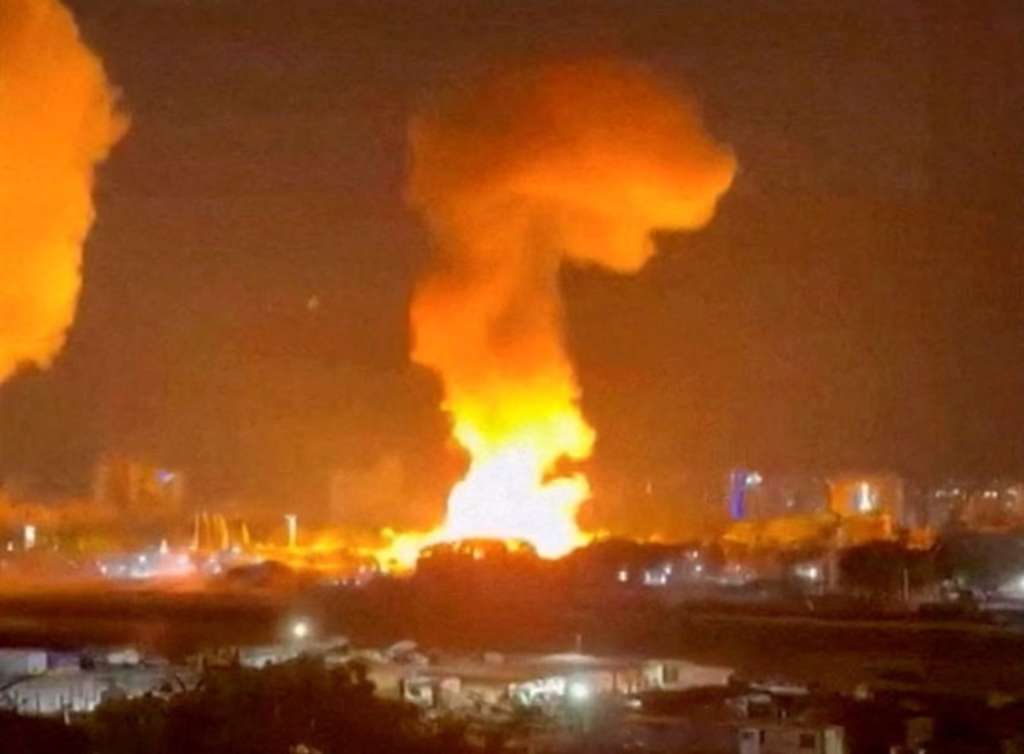
At approximately 2:00 a.m. local time, U.S. forces carried out coordinated airstrikes across northern Venezuela, focusing on areas around Caracas, the capital city. The strikes reportedly involved more than 150 aircraft, including fighter jets, bombers, helicopters, and surveillance drones.
Key military and infrastructure targets were hit, including:
- Military air bases near Caracas
- Radar and communications installations
- Port facilities near La Guaira, Venezuela’s main maritime gateway
- Antenna and command centers linked to national defense
According to U.S. officials, the strikes were designed to disable Venezuela’s military response and allow elite special forces to enter the capital.
Within hours, U.S. Delta Force units reportedly captured President Nicolás Maduro and First Lady Cilia Flores. They were flown out of Venezuela and transported to the United States, where American authorities later confirmed that both had been indicted on narcotics-related charges.
The Venezuelan government declared a national state of emergency, while senior officials accused Washington of violating international law and national sovereignty.
Why the US Attacked Venezuela
The roots of this moment go back several years, but tensions accelerated sharply in 2025.
Disputed Elections and Political Breakdown
Venezuela’s 2024 presidential election was widely criticized by international observers. While the country’s electoral authority declared Maduro the winner, opposition groups released parallel results claiming victory for their candidate.
The United States rejected the election outcome, accusing Maduro of fraud and labeling Venezuela a “narco-state”—a term implying that criminal drug networks operate with state support.
Escalation in 2025
By mid-2025, the U.S. had:
- Increased naval and military presence in the Caribbean
- Intercepted and seized Venezuelan oil shipments
- Designated key Venezuelan criminal groups as terrorist organizations
- Accused Maduro personally of leading narcotics trafficking networks
These actions were part of a broader campaign known as Operation Southern Spear, which Washington said targeted organized crime and illegal drug flows.
By late 2025, the U.S. had effectively imposed a maritime blockade on Venezuelan oil exports. The January 2026 strikes were the final escalation.
Legal and Political Controversy
The US attack on Venezuela immediately sparked intense legal and diplomatic backlash.
International Law Concerns
Many world leaders and international law experts argued that the strikes:
- Violated the UN Charter
- Breached Venezuela’s sovereignty
- Set a dangerous precedent for regime change by force
The United Nations Secretary-General described the action as a “dangerous precedent” and warned that it could destabilize the entire region.
US Domestic Debate
Inside the United States, the operation also raised constitutional questions. Reports indicate that Congress was not notified in advance, leading some lawmakers to question whether the president exceeded his authority.
Supporters argued the operation was justified due to criminal indictments and national security concerns. Critics called it illegal, reckless, and destabilizing.
Venezuela After the Attack
Despite Maduro’s capture, Venezuela’s government did not collapse.
Senior officials insisted that:
- Maduro remains the legitimate president
- The country will resist foreign control
- Venezuela will not become a U.S. “colony”
Power outages, airport restrictions, and disruptions to ports were reported in the days following the strikes. Civilian casualties were also reported, though exact numbers remain unclear.
Opposition leaders, meanwhile, called for a political transition and urged the international community to recognize an interim government.
Economic Impact on Venezuela
The economic consequences for Venezuela could be severe and long-lasting.
1. Oil Industry in Crisis
Oil is Venezuela’s economic lifeline. The country holds some of the largest proven oil reserves in the world, but production has already collapsed due to years of sanctions and mismanagement.
After the US attacks on Venezuela:
- Ports and storage facilities were damaged
- Tanker movements were disrupted
- Insurance costs for Venezuelan oil shipments surged
- Buyers became even more cautious
Even short-term disruption could cost Venezuela billions of dollars in lost revenue.
2. Currency and Inflation Pressure
Venezuela’s currency is already fragile. Military conflict adds:
- Capital flight
- Hoarding of U.S. dollars
- Higher inflation for food and fuel
Every day of instability increases hardship for ordinary citizens.
3. Investment Freeze
Foreign investors—already scarce—are likely to stay away entirely. Any hope of gradual economic recovery is now delayed indefinitely unless there is a clear and internationally recognized transition.
Economic Impact on the United States
While the U.S. economy is far larger and more resilient, the effects are still meaningful.
1. Oil Prices and Energy Markets
Global oil markets reacted quickly to the news:
- Venezuela’s exports are small but strategically important
- Any prolonged disruption tightens global supply
- Higher oil prices raise fuel costs worldwide
U.S. consumers could see higher gasoline prices, especially if tensions spread.
2. Military and Fiscal Costs
Even limited operations are expensive. Airstrikes, naval deployments, and long-term presence cost billions of dollars, adding pressure to the U.S. budget at a time of already high deficits.
3. Trade and Regional Stability
Latin America is a key trading partner for the U.S. Political instability in Venezuela:
- Raises risks for neighboring economies
- Increases migration pressures
- Complicates U.S. relations with allies
Impact on Global Markets
The US attacks on Venezuela are not just a regional issue.
- Emerging market assets face renewed volatility
- Oil and gas stocks may benefit short-term from higher prices
- Shipping and insurance costs in the Caribbean could rise
- Geopolitical risk premiums are increasing globally
Investors now have to factor Venezuela into broader risk calculations involving energy security and great-power rivalry.
A Turning Point in Global Order?
Beyond economics, this event may signal a deeper shift.
Analysts have compared the operation to past U.S. interventions, warning that:
- It weakens international norms
- Encourages power-based diplomacy
- Increases the risk of future unilateral actions by major powers
If force becomes a more accepted tool for resolving political disputes, global uncertainty will rise—and markets do not like uncertainty.
The US attack on Venezuela is one of the most significant geopolitical shocks of 2026 so far. It blends military action, energy politics, legal controversy, and economic fallout into a single event with global consequences.
For Venezuela, the risk is deeper economic collapse and prolonged instability.
For the United States, the challenge is balancing strategic goals against legal, financial, and diplomatic costs.
For the world, the concern is what precedent this sets in an already fragile global order.
Markets will be watching closely—not just what happens next in Caracas, but how Washington chooses to manage the aftermath.
Read also:
Trump Pressures Oil Giants on Venezuela as Markets Weigh Oil Impact