


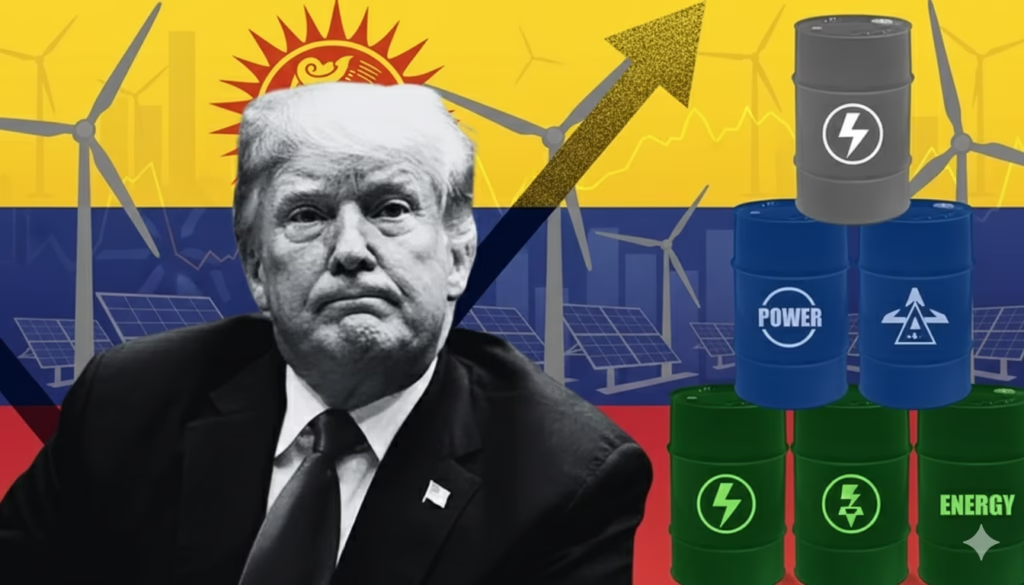
Introduction: Oil, Power, and a High-Stakes Gamble
The dramatic capture of Venezuelan President Nicolás Maduro by U.S. forces has sent shockwaves through global politics, financial markets, and the energy industry. But beyond the military operation itself, a quieter and arguably more consequential development is unfolding behind closed doors.
The Trump administration has delivered a firm private message to American oil companies: if they want compensation for assets seized by Venezuela decades ago, they must return now and rebuild the country’s shattered oil infrastructure. This approach ties long-awaited restitution to massive upfront investment, placing U.S. energy firms at the center of Venezuela’s uncertain future.
As Washington signals its intent to reshape Venezuela’s oil sector, investors are asking hard questions. Can Venezuela’s energy industry be revived? Will oil markets benefit? And what does this mean for the global economy at a time of weak crude prices and geopolitical tension?
This moment could redefine not just Venezuela’s economy, but also energy geopolitics across the Americas.
A Long Road from Nationalization to Collapse
Venezuela was once an oil powerhouse. In the 1970s, the country produced roughly 3.5 million barrels of oil per day, supported by a vast network of refineries, pipelines, and export terminals. That dominance faded after the government nationalized the oil industry, a process that began five decades ago and accelerated under former President Hugo Chávez.
Foreign oil companies lost billions of dollars in rigs, pipelines, and fields as assets were seized or contracts rewritten. Over time, mismanagement, corruption, and underinvestment hollowed out the industry. Today, Venezuela produces less than one-third of its peak output, despite sitting atop the world’s largest proven oil reserves.
Sanctions, political isolation, and the collapse of the state oil firm PdVSA left infrastructure rusting and skilled workers fleeing. What remains is a vast resource base trapped behind broken systems.
The Trump Administration’s Strategy: Rebuild First, Get Paid Later
According to people familiar with discussions between the White House and oil executives, the administration’s message is blunt: recovery of seized assets depends on companies committing to Venezuela now.
Rather than offering immediate compensation through legal settlements or international arbitration, Washington wants oil majors to reinvest directly. The expectation is that companies will spend billions of dollars repairing oil fields, pipelines, refineries, and export facilities, with reimbursement coming later through oil revenues or structured agreements.
President Donald Trump reinforced this view publicly, saying U.S. oil companies would “fix the badly broken infrastructure” and eventually “start making money for the country.”
From the administration’s perspective, this approach accomplishes several goals at once:
- Restores Venezuelan oil production without large U.S. taxpayer spending
- Puts American companies first in line for future profits
- Limits China’s access to discounted Venezuelan crude
- Strengthens U.S. influence over Western Hemisphere energy supplies
But for oil companies, the risks are substantial.
Industry Concerns: Uncertainty on Every Front
Despite the administration’s optimism, oil executives remain deeply cautious. Venezuela today presents commercial, political, and security risks that few energy projects can match.
Executives privately question:
- Who will govern Venezuela next, and for how long?
- Can worker safety and equipment security be guaranteed?
- How will companies be paid, and in what currency?
- Will contracts be respected under a future government?
- Can projects be profitable with oil prices near $50–$60 per barrel?
Many firms say they cannot even assess rebuilding costs because infrastructure decay is so severe. Oil fields that were once productive may require complete reconstruction, not just repairs.
One executive described the situation as “a shoot-ready-aim exercise,” suggesting that policy decisions are moving faster than planning.
PdVSA’s Future: Reform, Not Privatization
One notable detail emerging from discussions is that Venezuela’s state oil company, PdVSA, is unlikely to be dismantled or sold off, at least in the near term.
Instead, officials envision a wholesale replacement of PdVSA leadership while keeping the company intact to ensure continuity of operations. From a practical standpoint, this makes sense: PdVSA still controls much of the country’s infrastructure and workforce, despite its weakened state.
For investors, this signals that Venezuela may pursue a hybrid model, blending state control with foreign participation. That approach could reduce chaos but may limit how freely companies can operate.
Chevron’s Unique Position
Chevron stands apart as the only major U.S. oil company still operating in Venezuela, under a special U.S. government license. The company has emphasized compliance and employee safety, avoiding public speculation about future expansion.
Chevron’s experience may offer a blueprint for others — or serve as a cautionary tale. Its limited operations highlight both the potential upside and the constraints of working under political oversight.
Economic Impact: Venezuela’s Fragile Recovery
From an economic standpoint, Venezuela faces a long and uncertain recovery even under favorable conditions.
Short-Term Outlook
In the near term, the Venezuelan economy is unlikely to see immediate relief. Oil production cannot rebound quickly, and rebuilding infrastructure could take years, not months. Employment gains would be gradual, and inflation pressures may persist during the transition.
Medium- to Long-Term Potential
If stability improves and investment flows resume, oil could once again anchor Venezuela’s economy. Increased exports would generate foreign currency, stabilize government finances, and support broader economic activity.
However, this outcome depends heavily on:
- Political legitimacy of the next government
- Orderly transition of power
- Clear legal frameworks for foreign investors
Without those elements, capital will remain cautious.
Impact on Global Oil Markets
Supply: No Immediate Flood of Oil
Despite Venezuela’s vast reserves, global oil markets should not expect a sudden surge in supply. Any meaningful increase in production will take time and heavy investment.
This limits the downside risk for oil prices in the short term.
Prices: A Long-Term Balancing Factor
Over the long run, a revived Venezuela could act as a stabilizing force in global markets, especially as U.S. shale production slows. Venezuelan heavy crude is particularly valuable to Gulf Coast refineries designed to process it.
That could:
- Reduce reliance on Middle Eastern supply
- Lower transportation costs for U.S. refiners
- Improve energy security for North America
OPEC Questions
Venezuela’s status within OPEC remains unclear. Reentry or renegotiation of production quotas could affect cartel dynamics, particularly if Venezuela seeks to regain market share aggressively.
Geopolitical Stakes: China, Sanctions, and Energy Influence
One of Washington’s strongest motivations is geopolitical. China has been a major buyer of Venezuelan oil, often at steep discounts and through opaque shipping arrangements.
By bringing U.S. companies back first, the administration aims to:
- Push China out of Venezuela’s energy sector
- Reduce sanction evasion
- Reassert U.S. influence in Latin America
Energy, once again, is being used as a strategic tool.
Investor Takeaway: High Risk, High Reward — But Not Yet
For investors, Venezuela is not a near-term opportunity. The risks remain elevated, oil prices are low, and political outcomes are uncertain.
However, for long-term energy investors, Venezuela represents a potential strategic asset if stability improves. Companies with patience, political backing, and deep capital may eventually benefit — but only after significant hurdles are cleared.
As one analyst put it, Venezuela could become a “crown jewel” of global energy markets — if above-ground risks are removed.
Conclusion: A Defining Moment for Energy and Economics
The Trump administration’s push to tie compensation to reinvestment marks a bold and unconventional strategy. It places American oil companies at the heart of Venezuela’s recovery while shifting much of the financial risk onto the private sector.
For Venezuela, the coming months will determine whether this moment becomes the start of renewal or another chapter of uncertainty. For oil markets and the global economy, the outcome could shape supply, prices, and geopolitics for years to come.
For now, investors are watching — cautiously.
Read also:
US Attacks Venezuela: What Happened, Why It Matters, and the Economic Shockwaves Ahead