
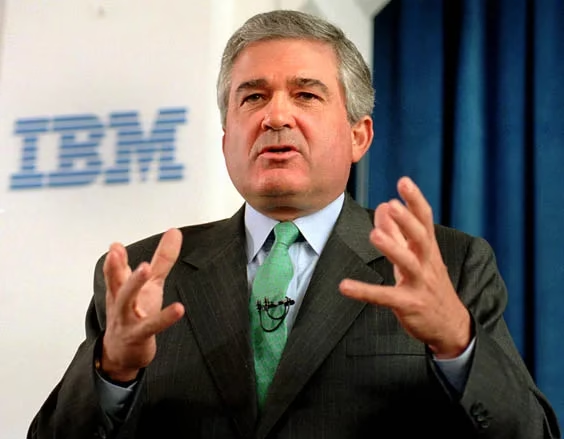
Lou Gerstner, the business leader widely credited with saving IBM from collapse and reshaping how American companies think about turnarounds, has died at the age of 83. His death was announced on December 27, 2025, by IBM chairman and CEO Arvind Krishna in an internal email to employees. No cause of death was disclosed.
Gerstner’s legacy is inseparable from one of the most dramatic corporate comebacks in modern history. When he took over IBM in 1993, the company was widely viewed as a relic of the past—too big, too slow, and too tied to an outdated business model to survive the rapid changes reshaping the technology industry. Less than a decade later, IBM had returned to strong profitability and emerged as a leader in enterprise services and consulting.
His turnaround of IBM did more than save a single company. It changed how boards, investors, and executives think about leadership, strategy, and what it takes to revive a struggling organization.
IBM on the Edge of Collapse
By the early 1990s, IBM was in deep trouble. Once the undisputed giant of computing, the company was losing billions of dollars as the industry shifted away from large mainframe systems toward personal computers and open software platforms. Competitors were moving faster, customers were looking elsewhere, and IBM’s internal structure had become rigid and fragmented.
In 1992 alone, IBM reported a loss of nearly $5 billion, one of the largest corporate losses in U.S. history at the time. Its stock price was falling, morale inside the company was low, and many analysts openly questioned whether IBM could survive as a single company.
The most popular proposal on Wall Street was to break IBM apart into smaller units—sometimes called “Baby Blues”—and sell them separately. The belief was that IBM was simply too large and complex to be fixed.
It was in this environment that Lou Gerstner stepped in.
An Unlikely Choice
When Gerstner became CEO on April 1, 1993, he was the first outsider ever to lead IBM. Even more surprising, he had no background in technology.
Gerstner held a bachelor’s degree in engineering from Dartmouth College and an MBA from Harvard Business School. His career had been built in management and operations, not software or hardware. He spent 13 years at McKinsey & Company, rising to director, before moving to American Express, where he spent 11 years as president and chairman. Later, he served as CEO of RJR Nabisco after its high-profile leveraged buyout.
To many observers, hiring a non-technology executive to run a struggling tech giant seemed risky. But that outsider perspective turned out to be one of Gerstner’s greatest strengths.
Rather than focusing on technology for its own sake, he focused on customers, execution, and financial discipline.
Refusing to Break IBM Apart
One of Gerstner’s first and most important decisions was to reject the idea of breaking up IBM.
At the time, this went against conventional wisdom. Investors and analysts believed the company’s size was its biggest weakness. Gerstner saw things differently. He believed IBM’s true value lay in its ability to bring together hardware, software, and services to solve large, complex problems for corporate clients.
Instead of dismantling the company, he chose to keep it together and reshape how it operated.
This decision would define IBM’s future.
Tough Decisions and Hard Choices
Saving IBM required swift and painful action.
Gerstner launched aggressive cost-cutting measures and sold off assets that were not contributing to the company’s recovery. This included real estate holdings and even IBM’s prized art collection. He made it clear that nothing was off-limits if it did not serve the company’s future.
One of his most controversial moves was reducing IBM’s workforce. Over several years, around 35,000 jobs were eliminated from a company that had long promised near-lifetime employment. This marked a dramatic break from IBM’s traditional culture, which dated back to the early leadership of Thomas Watson Sr.
Gerstner believed that accountability had to replace entitlement. He often said that organizations improve not through slogans, but through clear goals and consistent follow-through. One of his most quoted lines captured this philosophy: “People do what you inspect, not what you expect.”
Changing the Way IBM Worked
Beyond cutting costs, Gerstner focused on changing how IBM operated internally.
Previously, IBM’s divisions often acted like separate companies, competing with one another rather than working together. Compensation and bonuses were tied to the performance of individual units, not the company as a whole.
Gerstner ended this system. He restructured pay and incentives so that success was measured at the corporate level. Employees were rewarded for teamwork and collaboration rather than narrow departmental wins.
This shift helped break down internal barriers and encouraged IBM to present itself as one company to its customers.
A Major Shift in Strategy
Perhaps Gerstner’s most lasting contribution was his decision to move IBM away from its heavy reliance on hardware and toward services and consulting.
He recognized that customers no longer wanted just machines or software. They wanted solutions—help integrating technology into their businesses, managing complex systems, and adapting to rapid change.
Under his leadership, IBM invested heavily in enterprise services, consulting, and customer support. The company also committed to open industry standards, moving away from its old practice of selling products that only worked with other IBM systems.
Some long-standing projects were abandoned. Gerstner shut down OS/2, an operating system designed to compete with Microsoft Windows, after concluding that it no longer made sense for IBM’s future.
These decisions were not always popular internally, but they were guided by one principle: focus on what customers actually needed.
A Remarkable Turnaround
The results were striking.
Within two years of Gerstner taking over, IBM returned to profitability, posting a net profit of $4.2 billion. Investor confidence improved, customers returned, and the company’s reputation began to recover.
By the early 2000s, IBM had repositioned itself as a leader in enterprise services and consulting—a business model that would sustain it for decades.
Gerstner served as CEO until March 2002 and remained chairman until December of that year, completing nearly a decade at the helm during one of the most challenging periods in the company’s history.
Life After IBM
After retiring from IBM, Gerstner continued to play an influential role in the business world. He served as chairman of The Carlyle Group from 2003 to 2008, overseeing the global investment firm during a period of expansion.
He also became a respected voice on leadership and organizational change. His memoir, Who Says Elephants Can’t Dance?, offered a candid account of IBM’s turnaround and became required reading in many business schools.
The book emphasized practical leadership lessons rather than theory, reflecting Gerstner’s belief that success comes from execution, not slogans.
Industry Reaction and Lasting Influence
In announcing Gerstner’s death, IBM CEO Arvind Krishna credited him with reshaping the company by focusing not on its past, but on its customers’ future needs.
Gerstner’s tenure is still widely studied as a model for corporate turnaround. His approach—prioritizing customers, enforcing accountability, aligning incentives, and making difficult decisions quickly—remains relevant for leaders facing disruption today.
At a time when many companies struggle to adapt to new technologies and changing markets, Gerstner’s experience offers a reminder that size and history do not have to be weaknesses—if leadership is willing to change.
Why Lou Gerstner Still Matters
Lou Gerstner’s story matters because it shows that even the most troubled organizations can be revived with clear thinking and decisive leadership.
He proved that leaders do not need to be technical experts to run technology companies. They need to understand customers, motivate people, and make tough choices without hesitation.
His refusal to break up IBM, once seen as risky, turned out to be a defining insight. By keeping the company together and changing its direction, he preserved its ability to serve large global clients in ways smaller rivals could not.
As businesses today face economic uncertainty, technological shifts, and pressure from investors, Gerstner’s legacy remains a powerful example of how focus, discipline, and courage can change the course of even the largest institutions.
Lou Gerstner did not just save IBM. He reshaped the playbook for corporate leadership—and that influence will endure long after his passing.
Other posts you might be interested in:
SpaceX Launch Delayed: What the Final Falcon 9 Mission Means for 2025
Oman’s Wedding and Luxury Tourism Boom Fuels Economic Growth