


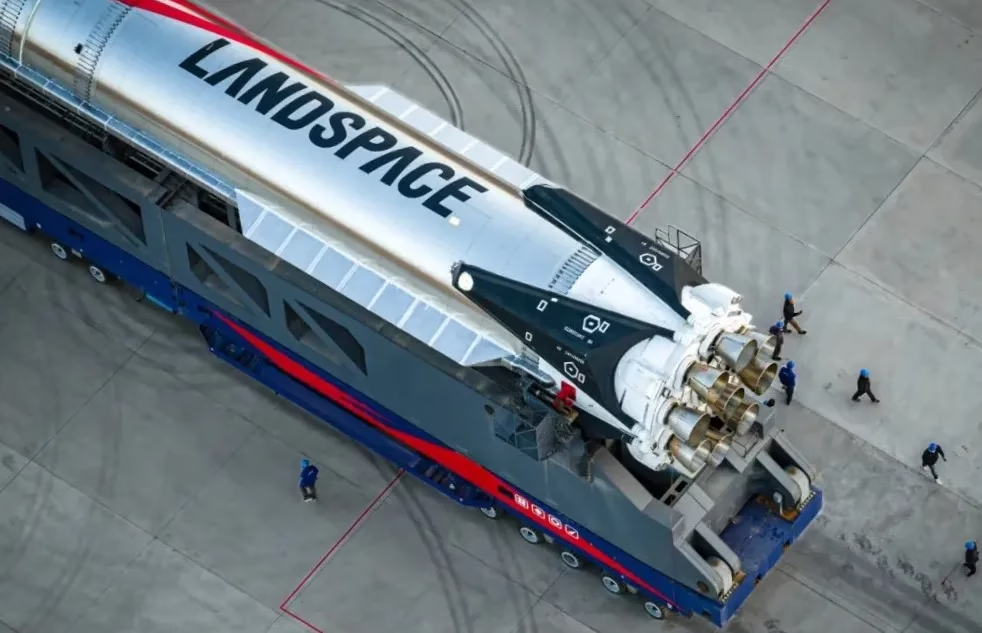
China’s private space sector is entering a new and ambitious phase, and one company is increasingly drawing global attention: LandSpace. The Beijing-based rocket startup is openly modeling itself on Elon Musk’s SpaceX, signaling China’s intent to compete not just in space exploration, but in the commercial space economy as well.
Earlier this month, LandSpace became the first Chinese company to test a reusable rocket, a milestone that puts it closer to SpaceX’s most powerful advantage—lower launch costs through reusability. While the test flight of its Zhuque-3 rocket ultimately failed, the attempt itself marks a major shift in how China approaches space technology.
Unlike China’s traditional, state-led space programs—where failure is rarely tolerated or publicly discussed—LandSpace is embracing a trial-and-error approach similar to Silicon Valley startups. That mindset is already reshaping China’s space industry.
Learning from SpaceX, Not Copying It
LandSpace executives have been clear about their inspiration. Zhuque-3’s chief designer, Dai Zheng, previously worked at China’s main state rocket developer before leaving in 2016 to join LandSpace. His motivation was simple: SpaceX had proven that reusable rockets could dramatically cut costs and accelerate innovation.
According to Dai, SpaceX’s willingness to push boundaries—even at the cost of public failures—was something China lacked. LandSpace aims to change that.
Another senior engineer at the company described Zhuque-3 as a design that studies SpaceX’s Falcon 9 because it works. In his words, learning from a proven model is not imitation—it is good engineering. Being compared to Falcon 9, he said, is a compliment.
A Big Goal: Powering China’s Satellite Boom
LandSpace’s ambitions are closely aligned with China’s broader economic and strategic goals. Beijing plans to deploy tens of thousands of satellites over the coming decades for communications, navigation, and Earth observation.
To do that at scale, China needs cheap and frequent launches—something SpaceX has mastered with reusable rockets. LandSpace hopes Zhuque-3 can become China’s equivalent: a dependable, low-cost launch vehicle that can fly repeatedly.
If successful, this would reduce China’s reliance on expensive state-owned launch systems and allow private firms to compete in the fast-growing global satellite market.
Failure, Publicly Acknowledged
The December test flight did not go as planned. Zhuque-3’s booster failed to ignite its landing burn just a few kilometers above the ground, resulting in a crash instead of a controlled landing.
But instead of burying the failure, Chinese state media reported it openly—a notable change from past practice. Even more striking, a state-owned firm attempted a similar reusable rocket recovery weeks later, and that test also failed.
This openness suggests that LandSpace’s startup culture is influencing even China’s traditional space institutions.
Capital Markets Enter the Picture
LandSpace is now preparing for a potential initial public offering (IPO), a move that reflects China’s growing support for private space companies to access funding from capital markets.
This is crucial. SpaceX has survived years of heavy losses thanks to massive private investment. Elon Musk was able to fund repeated failures during the development of Starship because investors believed in the long-term payoff.
LandSpace does not yet have that financial cushion. Company executives have acknowledged that without strong capital market support, it is difficult to take the same risks as SpaceX.
China appears to recognize this challenge. Regulators are increasingly encouraging leading private tech firms—especially in strategic sectors like space—to raise money publicly.
Even Elon Musk Is Paying Attention
LandSpace’s progress has not gone unnoticed. In October, Elon Musk commented publicly on Zhuque-3 after watching a video of the rocket’s assembly.
He noted that the Chinese rocket combines elements of SpaceX’s Starship, such as stainless steel construction and methane-based fuel, with a Falcon 9-style structure. According to Musk, this design could potentially outperform Falcon 9—though he added that Starship remains in a different league.
Such comments are significant. Musk rarely acknowledges competitors, and his remarks suggest LandSpace is being taken seriously.
Why Reusable Rockets Matter Financially
From a business perspective, reusable rockets are the single biggest cost-saving breakthrough in the space industry.
Traditional rockets are discarded after one flight, making each launch extremely expensive. Reusable rockets allow companies to recover and fly the most costly parts—especially engines—multiple times.
This changes the economics entirely. Lower costs mean more launches, more satellites, and new commercial opportunities ranging from broadband internet to Earth imaging and defense contracts.
LandSpace’s use of stainless steel and methane fuel reflects this cost-focused approach. These materials are cheaper, easier to manufacture, and better suited for reuse than older designs.
SpaceX’s Long Road Offers a Lesson
LandSpace can take some comfort in history. SpaceX’s first successful Falcon 9 booster landing did not happen until 2015—after multiple failed attempts.
At the time, critics questioned whether reusable rockets were practical at all. Today, SpaceX dominates the global launch market, flying reused boosters regularly and at a fraction of competitors’ costs.
LandSpace is still early in that journey.
Analysis: What LandSpace Means for Investors and Markets
LandSpace’s rise highlights several important trends for investors and policymakers:
First, China is serious about building a competitive commercial space sector. This is not just about national pride—it is about owning future infrastructure, from satellites to global communications.
Second, the willingness to tolerate failure marks a cultural shift that could spill into other high-tech industries. Innovation at scale requires experimentation, and LandSpace is helping normalize that idea in China.
Third, if LandSpace successfully goes public, it could open the door for space-focused investment opportunities in China, similar to how SpaceX reshaped private investment in the U.S.
Finally, competition between SpaceX and Chinese firms could drive down launch costs globally, benefiting satellite operators, telecom companies, and even emerging markets that depend on space-based services.
While SpaceX remains far ahead, LandSpace’s progress suggests that the global space economy is moving toward a more competitive, multi-player future—and that has major financial implications.
For investors watching long-term technology shifts, space is no longer science fiction. It is becoming a serious business.
Other posts you might be interested in:
Lou Gerstner Dies at 83: The CEO Who Saved IBM and Changed Corporate Turnarounds
Brian Moynihan on the 2026 Economy: AI, Growth and Market Risks