What Is GDP? Definition, Formula, Types & Why It Matters
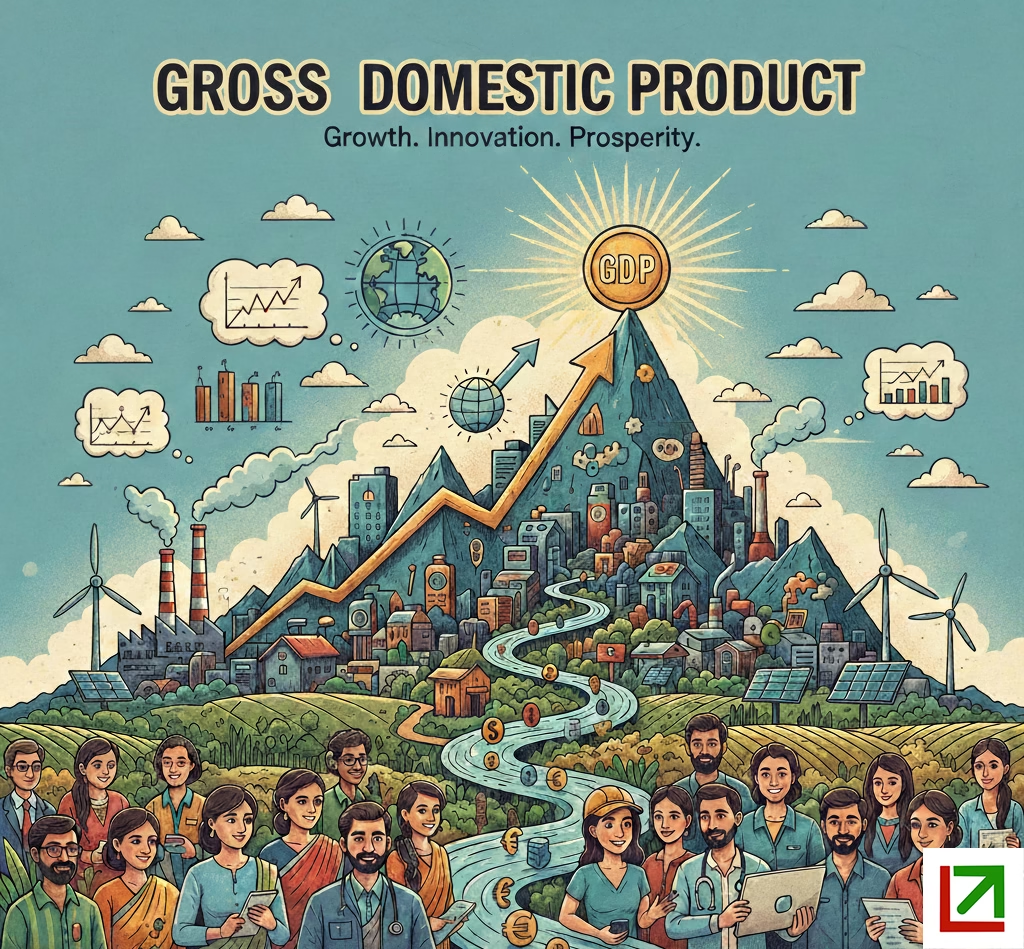
Gross Domestic Product (GDP), is one of the most widely used terms in economics and finance. You hear it in news headlines, government reports, central bank announcements, and market discussions. When GDP is rising, optimism usually follows. When it falls, fear of recession spreads.
But what is GDP exactly?
Why does it matter so much?
And just as importantly- what doesn’t GDP tell us?
This detailed guide breaks down GDP in simple terms, explains how it’s measured, how to compare countries, and why GDP alone does not define well-being. Whether you’re a student, investor, or curious reader, this article will give you a complete and practical understanding of GDP, without heavy jargon.
What Is Gross Domestic Product (GDP)?
Gross Domestic Product (GDP) measures the total monetary value of all final goods and services produced within a country’s borders during a specific time period, usually a quarter or a year.
In simple words, GDP answers one basic question:
How much did a country produce?
If factories produce more goods, people consume more services, governments spend more, and exports increase, GDP rises. If production slows, spending drops, or businesses cut investment, GDP falls.
Because of this, GDP is widely used as a scorecard for economic performance.
Why GDP Matters
GDP is important because it helps answer key economic questions:
- Is the economy growing or shrinking?
- Are people likely to find jobs?
- Is business activity expanding?
- Is government revenue likely to rise or fall?
In general:
- Rising GDP → more jobs, higher incomes, stronger business confidence
- Falling GDP → job losses, lower spending, economic stress
When GDP grows steadily and inflation remains under control, both businesses and workers tend to benefit.
What GDP Includes (and What It Doesn’t)
Included in GDP
GDP counts:
- Goods produced for sale (cars, food, electronics)
- Services provided for money (healthcare, education, banking)
- Government services (defense, public education, infrastructure)
- Investment by businesses (machinery, buildings, software)
- Goods produced for own use (like home-grown vegetables, in some cases)
Not Included in GDP
GDP does not include:
- Unpaid household work (cleaning, cooking at home)
- Volunteer services
- Illegal or underground activities that can’t be reliably measured
- Intermediate goods (to avoid double counting)
Example:
A baker selling bread contributes to GDP.
The same baker making bread for their family does not.
GDP vs GNP vs GNI: What’s the Difference?
GDP isn’t the only way to measure economic activity.
GDP (Gross Domestic Product)
- Measures production within a country’s borders
- Ownership doesn’t matter
GNP (Gross National Product)
- Measures production by a country’s residents and companies
- Includes income earned abroad
- Excludes foreign-owned production at home
GNI (Gross National Income)
- Focuses on income earned by residents
- Includes wages, profits, and income from abroad
Example:
If a German company operates a factory in the U.S.:
- Output counts in U.S. GDP
- Output counts in Germany’s GNP
Why GDP Is Called “Gross”
GDP is described as “gross” because it does not subtract depreciation.
Depreciation refers to the wear and tear on:
- Machines
- Buildings
- Equipment
If depreciation is subtracted from GDP, the result is called:
Net Domestic Product (NDP)
GDP shows total output, but not how much of that output is used just to replace aging assets.
Three Ways to Measure GDP
Even though GDP can be calculated in different ways, all methods should arrive at the same final number.
1. Production (Value-Added) Approach
This method adds the value created at each stage of production.
Value-added = Output value – Cost of intermediate inputs
Example:
- Wheat → Flour → Bread
Only the final value of bread is counted.
2. Expenditure Approach (Most Common)
This approach adds up total spending by final users in the economy.
GDP Formula
GDP = C + I + G + NX
Where:
- C = Consumer spending
- I = Investment
- G = Government spending
- NX = Net exports (Exports – Imports)
Consumer Spending (C)
The largest part of GDP.
Includes:
- Food
- Clothing
- Healthcare
- Entertainment
- Services
Consumer confidence plays a huge role here.
Investment (I)
Includes:
- Business machinery
- Factories
- Infrastructure
- Software
- Inventory changes
Investment increases future production capacity.
Government Spending (G)
Includes:
- Salaries
- Roads
- Schools
- Defense
- Public services
Transfer payments like pensions are not included.
Net Exports (NX)
- Exports increase GDP
- Imports reduce GDP
A trade surplus boosts GDP.
A trade deficit reduces GDP.
3. Income Approach
This method adds up:
- Wages
- Profits
- Rents
- Interest
- Taxes minus subsidies
It tracks who earns income from production.
Nominal GDP vs Real GDP
Nominal GDP
- Measured at current prices
- Includes inflation
Real GDP
- Adjusted for inflation
- Reflects true growth in production
Why Real GDP Matters:
If GDP rises only because prices increased, the economy may not actually be producing more.
Example:
If nominal GDP rises 50%, but prices double, real GDP has actually fallen.
GDP Growth and Economic Cycles
Economies move in cycles:
- Expansion
- Peak
- Slowdown
- Recession
- Recovery
A common rule:
Two consecutive quarters of declining real GDP = recession
However, institutions like the National Bureau of Economic Research (NBER) use broader indicators, not GDP alone.
GDP Per Capita: Living Standards
GDP per capita divides GDP by population.
It helps compare:
- Living standards
- Productivity
- Income levels
But it still does not show income distribution.
Comparing GDP Across Countries
GDP is measured in local currencies. To compare countries, values are converted into U.S. dollars using:
1. Market Exchange Rates
- Based on forex markets
- Can distort living standards
2. Purchasing Power Parity (PPP)
- Adjusts for cost of living
- More accurate for comparisons
PPP often shows higher GDP for emerging economies because goods and services are cheaper locally.
Who Uses GDP and Why?
Governments
- Design tax and spending policies
- Assess growth or recession
Central Banks
- Set interest rates
- Control inflation
Businesses
- Plan expansion
- Forecast demand
Investors
- Allocate capital
- Assess country risk
International Institutions
- Compare economies
- Track global growth
What GDP Does Not Reveal
GDP has serious limitations:
- Doesn’t measure happiness
- Ignores inequality
- Overlooks environmental damage
- Excludes unpaid work
- Doesn’t reflect leisure or quality of life
A country can have rising GDP while:
- Pollution worsens
- Wealth becomes concentrated
- Work-life balance declines
Alternatives to GDP
To address GDP’s weaknesses, other measures exist:
Human Development Index (HDI)
- Life expectancy
- Education
- Income
Genuine Progress Indicator (GPI)
- Adjusts for social and environmental costs
Gross National Happiness (GNH)
- Focuses on well-being
Each has strengths, but none have replaced GDP’s dominance.
Final Thoughts: Why GDP Still Matters
GDP is not perfect, but it remains the most powerful single indicator of economic activity.
It tells us:
- How large an economy is
- How fast it’s growing
- Where cycles are heading
Used wisely, alongside other indicators, GDP remains an essential tool for understanding economies in a complex world.
Frequently Asked Questions (FAQs)
What is GDP in simple terms?
GDP is the total value of all goods and services produced within a country over a specific period.
Why is GDP important?
GDP helps measure economic growth, employment trends, and overall economic health.
What is the difference between real GDP and nominal GDP?
Nominal GDP includes inflation, while real GDP is adjusted for inflation and shows true economic growth.
Does GDP measure living standards?
No. GDP measures output, not income distribution, happiness, or quality of life.
How often is GDP calculated?
Most countries calculate GDP quarterly and annually.
Other topics you might be interested in:
What Is the Federal Reserve? Meaning, Role and Why It Matters
What Is Inflation? Meaning, Causes and How It Affects Consumers
What Are Interest Rates and Why They Matter to the Economy?
Economic Data Explained: How Macro Numbers Shape Financial Markets
What Is Consumer Price Index (CPI)? Meaning, Calculation, and Why It Matters
Recession: Definition, Causes, Examples, and How It Affects You