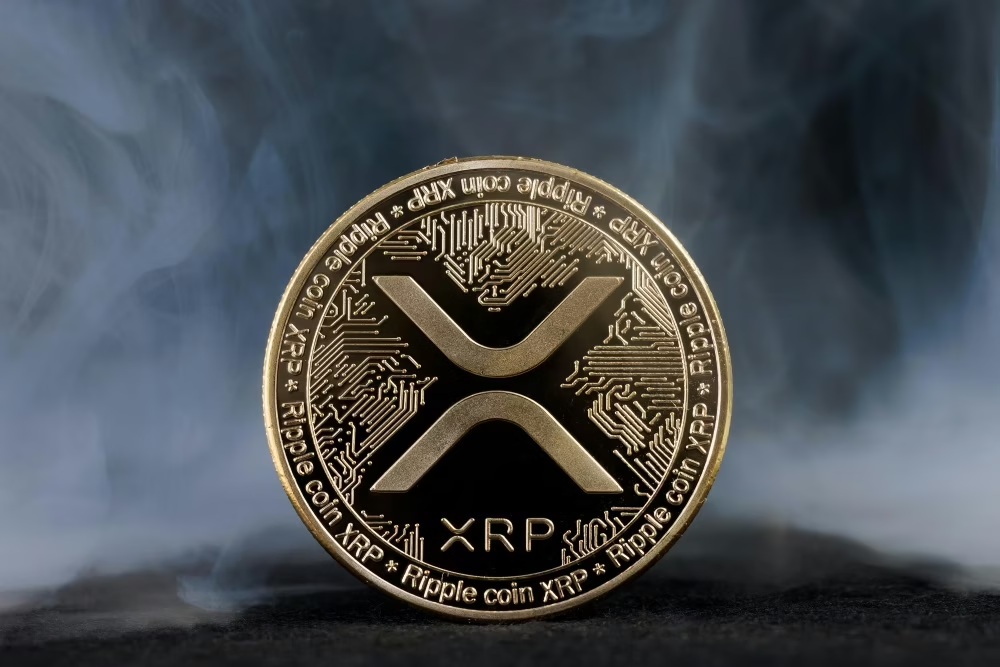
XRP has entered 2026 with renewed momentum, rising more than 18% in the first few days of the year. The move places XRP above the $2.15 level and reflects a broader improvement across the digital asset market. Bitcoin, Ethereum, and other major cryptocurrencies have also advanced, pushing the total crypto market value up more than 7% so far this year.
What makes XRP’s rally stand out is not just the price increase, but the combination of improving chart patterns, steady institutional buying, and shrinking available supply. Together, these factors suggest XRP may be moving from a recovery phase into a stronger growth phase after a long period of consolidation.
A Key Shift in XRP’s Price Structure
For much of 2025, XRP traded in a slow downward drift, frustrating many investors. Prices made lower highs and lower lows, which often signals weakness. However, this pattern gradually tightened, meaning selling pressure was losing strength.
In early January 2026, XRP finally broke out of this declining structure. This type of breakout often marks the end of a correction rather than the start of a new downturn. Since then, XRP has held above the $2.05–$2.10 range, a zone that previously acted as resistance.
The next challenge lies near $2.35, a level that has repeatedly stopped rallies in the past. If XRP can stay above current prices and push through that area, it could open the door to a move toward $2.60 or higher over the coming weeks.
Rather than rising on hype alone, the recent price move appears supported by improving market participation and steadier buying activity.
A Longer-Term Accumulation Story
Beyond short-term price action, XRP’s behavior over the past year fits a broader pattern often associated with large investors quietly building positions.
After falling toward $1.20 in late 2024, XRP stabilized instead of collapsing further. Throughout most of 2025, prices moved sideways between roughly $1.70 and $2.00. While this looked boring to many traders, it allowed long-term buyers to accumulate XRP without pushing prices sharply higher.
In late 2025, XRP briefly dipped below support near $1.70, only to recover quickly. This type of move often shakes out impatient sellers before a stronger advance begins. By early 2026, XRP was again testing the upper boundary of its long-standing range.
If prices can remain above the $2.10–$2.15 area, it would confirm that XRP has left its consolidation phase behind. From there, the next logical targets would sit between $2.80 and $3.20. Some longer-range projections even extend much higher, though those would depend on sustained demand and favorable market conditions.
Why XRP ETFs Are Attracting Capital
One of the most important developments supporting XRP is the continued growth of spot XRP exchange-traded funds (ETFs) in the United States.
During December 2025 alone, XRP ETFs attracted approximately $483 million in new capital. This happened at the same time Bitcoin ETFs lost more than $1 billion and Ethereum ETFs saw outflows exceeding $500 million. Even more striking, XRP’s price fell about 15% during that month, yet institutions kept buying.
This gap between price movement and institutional behavior highlights a key difference between professional investors and retail traders. While many individual traders reacted to short-term price weakness by selling, institutions focused on long-term positioning. For them, lower prices provided an opportunity rather than a warning sign.
Since their launch in November, XRP ETFs have accumulated around $1.3 billion in total inflows. This marks the fastest adoption rate ever seen for an altcoin ETF. Importantly, the inflows were steady and spread across multiple fund providers, suggesting broad institutional interest rather than a single large buyer.
Supply Is Getting Tighter
At the same time demand has increased, the available supply of XRP on exchanges has continued to decline. On-chain data shows that exchange balances have fallen to their lowest levels since 2018.
When fewer coins are held on exchanges, it usually means investors are moving assets into long-term storage rather than preparing to sell. This reduces immediate selling pressure and can amplify price moves if demand increases.
Historically, periods where rising institutional demand meets shrinking exchange supply have often preceded stronger price trends across the crypto market.
Signs of Improving Market Behavior
Recent trading data also suggests that buying pressure is strengthening. The ratio comparing aggressive buyers to aggressive sellers has climbed to its highest level in over a month. In simple terms, more traders are willing to buy at current prices instead of waiting for dips.
This shift comes after a weak period in mid-December and supports the idea that market sentiment is improving. If this buying strength continues, it could help XRP hold recent gains and build a more stable uptrend.
Long-Term Expectations Are Rising
Reflecting these developments, some major financial institutions have raised their long-term expectations for XRP. Standard Chartered, for example, has suggested XRP could reach around $8 by 2026, citing increased institutional participation, regulatory clarity, and expanding use cases.
While such projections are not guarantees, they underline how perceptions around XRP have shifted compared to previous years.
Analysis: What This Means for XRP Going Forward
XRP’s early-2026 strength is not just about price moving higher. It is about how and why it is moving.
First, institutions are clearly treating XRP as a long-term allocation rather than a short-term trade. The steady ETF inflows during a price decline make that clear. Second, supply conditions are improving, with fewer tokens readily available for sale. Third, market behavior is shifting from defensive selling to cautious buying.
That does not mean XRP will move straight up. Resistance levels still matter, and broader market conditions will play a major role. However, compared to recent years, XRP now shows a healthier structure: calmer accumulation, stronger demand, and improving confidence.
In simple terms, XRP appears to be transitioning from recovery to growth. Whether it reaches ambitious price targets will depend on follow-through and patience—but the foundation supporting the asset looks stronger than it has in a long time.
For investors and observers alike, XRP in 2026 is no longer just a speculative story. It is increasingly becoming a case study in how institutional demand, supply dynamics, and time can quietly reshape a market.
Read also:
Broadcom (AVGO) Beat Nvidia in 2025: Buy, Sell, or Hold in 2026?
Exxon Mobil Stock (XOM) Surges After Trump Hints at Venezuela Oil Control
Global Markets React Cautiously After US Captures Venezuela’s President