


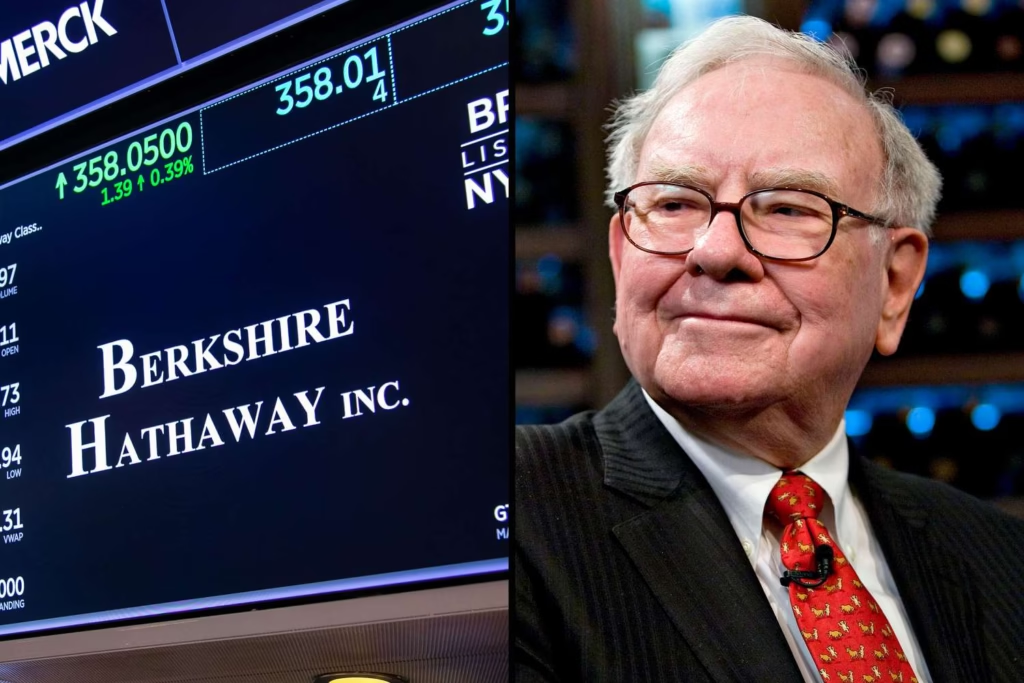
After nearly six decades at the helm, Warren Buffett has stepped aside as Chief Executive Officer of Berkshire Hathaway (BRKa.N), bringing one of the most remarkable leadership chapters in modern business history to a close. Known globally as the “Oracle of Omaha,” Buffett has shaped not only a company, but the way millions of investors think about money, patience, and long-term value.
At 95, Buffett is handing over day-to-day control of the company to Greg Abel, a longtime insider and trusted lieutenant. While Buffett will no longer serve as CEO, he will remain chairman of Berkshire Hathaway’s board, offering guidance and continuity as the company moves into a new phase.
Why This Moment Matters
Buffett has led Berkshire Hathaway since 1965, making his tenure one of the longest ever for a chief executive of a major corporation. His decision to step down signals a generational shift at a company that has become a benchmark for disciplined investing and steady growth.
Greg Abel will officially take over as CEO on January 1, 2026. The transition has been planned for years, reassuring investors that Berkshire’s culture and decision-making approach will remain steady rather than abrupt.
Buffett’s Long Journey With Berkshire Hathaway
When Warren Buffett first gained control of Berkshire Hathaway, the company was far from the powerhouse it is today. It began as a struggling textile manufacturer based in New England. Buffett initially hoped to turn the textile business around, but he soon realized that its future was limited.
Rather than cling to a failing model, Buffett made a pivotal choice: he redirected the company’s capital into insurance and investments. This shift became the foundation of Berkshire Hathaway’s transformation.
Insurance businesses like GEICO provided steady cash flows, which Buffett then used to invest in other companies. Over time, Berkshire evolved into a diversified holding company with interests across insurance, energy, transportation, manufacturing, and consumer goods.
Building a $1 Trillion Conglomerate
Under Buffett’s leadership, Berkshire Hathaway grew into a global conglomerate valued at more than $1 trillion, becoming the first non-technology company to reach that milestone. Its strength lies in a mix of fully owned businesses and long-term investments in public companies.
Berkshire owns well-known businesses outright, including BNSF Railway, GEICO, Berkshire Hathaway Energy, and dozens of manufacturing and retail companies. At the same time, it holds major stakes in publicly traded firms such as Apple, Coca-Cola, American Express, and Bank of America.
Buffett’s approach was simple but disciplined. He preferred businesses that were easy to understand, financially strong, and run by capable managers. He avoided chasing trends and focused instead on durability and long-term potential.
A Unique Management Style
One of Buffett’s most lasting contributions was his management philosophy. Berkshire Hathaway operates with a highly decentralized structure. Managers of its many subsidiaries are given wide freedom to run their businesses, as long as they follow clear ethical standards and use capital wisely.
Buffett himself remained deeply involved in deciding where money should be invested, but he avoided micromanaging daily operations. This trust-based system attracted talented leaders and helped Berkshire grow without becoming rigid or overly bureaucratic.
Beyond the numbers, Buffett’s annual shareholder letters became essential reading for investors worldwide. Written in plain language, they explained complex ideas simply and emphasized patience, discipline, and humility. The company’s annual meetings in Omaha turned into global events, drawing tens of thousands of shareholders each year.
The Leadership Transition to Greg Abel
Greg Abel, currently vice chairman overseeing Berkshire’s non-insurance businesses, has long been seen as Buffett’s successor. His appointment reflects continuity rather than change.
Abel played a key role in expanding Berkshire Hathaway Energy and overseeing large infrastructure investments. In recent years, Buffett gradually handed him more responsibility, including some capital allocation decisions.
From 2026 onward, Abel will take over writing Berkshire’s annual shareholder letter, a tradition Buffett maintained since the 1960s. Buffett, meanwhile, plans to reduce his public appearances but will continue to share occasional messages, including his well-known Thanksgiving notes.
Who Is Greg Abel?
Gregory Edward Abel was born on June 1, 1962, in Edmonton, Canada, and grew up in a working-class household. As a young man, he took on various odd jobs, including collecting discarded bottles and refilling fire extinguishers, experiences that shaped his work ethic.
After graduating from the University of Alberta, Abel worked at PricewaterhouseCoopers and later at the energy company CalEnergy. He joined MidAmerican Energy in 1992, which was later acquired by Berkshire Hathaway.
As chairman of Berkshire Hathaway Energy, Abel oversaw complex operations across energy, chemicals, industrials, and retail. Colleagues describe him as detail-oriented, deeply curious, and focused on understanding how businesses really function.
His name has been discussed as Buffett’s successor for more than a decade. The late Charlie Munger, Buffett’s longtime partner, once described Abel as a “world-class” executive, a strong endorsement within Berkshire’s leadership circle.
What Investors Are Watching Now
Buffett’s legacy casts a long shadow. His success in spotting undervalued companies and holding them for decades has become legendary. Guided early on by value investing pioneer Benjamin Graham, Buffett refined an approach centered on buying strong businesses at reasonable prices and holding them patiently.
With Abel stepping in, investors are watching closely to see whether Berkshire’s investment style will evolve. So far, Abel has emphasized that the company’s philosophy will remain unchanged.
Unlike Buffett, Abel has kept a low public profile, giving few interviews. This has left markets curious about how he might respond to future challenges, especially as industries change faster than they did in Buffett’s early years.
One area of interest is technology. Berkshire was cautious about tech investments for decades, citing rapid change and uncertainty. Its large investment in Apple beginning in 2016 marked a notable shift, and how Abel approaches technology going forward will be closely followed.
Analysis: What Buffett’s Exit Really Means
Warren Buffett stepping down as CEO is symbolic more than disruptive. Berkshire Hathaway has been preparing for this moment for years, and the transition appears carefully designed to avoid sudden shocks.
Buffett’s continued role as chairman provides reassurance, while Greg Abel’s long tenure inside the company suggests stability rather than reinvention. For investors, the key takeaway is that Berkshire’s core principles—long-term thinking, cautious use of capital, and trust in managers—are unlikely to change overnight.
That said, the world Abel inherits is different from the one Buffett dominated. Markets move faster, technology plays a bigger role, and competition for high-quality businesses is intense. Abel’s challenge will be to apply Berkshire’s timeless philosophy in a changing environment, without relying on Buffett’s unmatched reputation.
The end of Buffett’s CEO tenure closes a historic chapter, but it does not close the book on Berkshire Hathaway. Instead, it opens a new one—written by a successor shaped by the same values, but tested by a very different future.
Other articles you might be interested in:
China AI Chipmaker Biren Technology Doubles on Hong Kong IPO Debut
US Air Force Awards $2B Contract to Upgrade B-52 Bomber Engines