


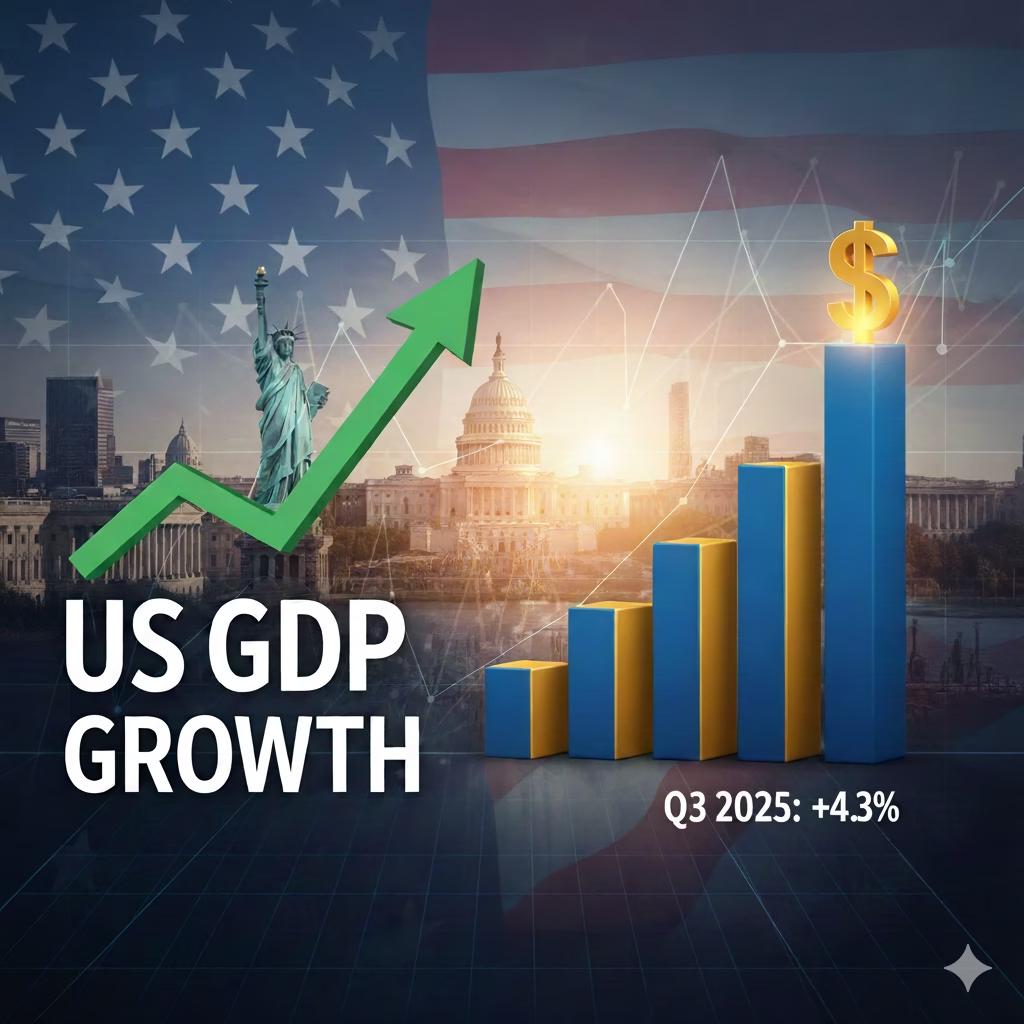
The US GDP delivered a powerful surprise in the third quarter, growing at an annualized rate of 4.3%, far exceeding economists’ expectations and marking the fastest pace of expansion in nearly two years. The data, released by the Commerce Department after a significant delay caused by the federal government shutdown, paints a picture of an economy that remains resilient despite persistent inflation, political uncertainty, and shifting monetary policy.
While markets showed little reaction to the report—largely because the data looks backward—the implications for consumers, businesses, and policymakers are significant. From strong consumer spending and surging corporate profits to stubborn inflation pressures and Federal Reserve uncertainty, the third-quarter US GDP report offers valuable insight into where the U.S. economy stands as it heads toward the end of the year.


A Stronger-Than-Expected Economic Performance
Gross domestic product (GDP), the broadest measure of economic activity, expanded at a 4.3% annualized rate during the July–September period. This figure sharply beat the 3.2% growth forecast by economists surveyed by Dow Jones and accelerated from the 3.8% growth rate recorded in the second quarter.
According to the Bureau of Economic Analysis (BEA), this surge was driven primarily by robust consumer spending, increased exports, and higher government expenditures. These gains were partially offset by a decline in private investment, although that contraction was smaller than initially anticipated.
The third-quarter result represents the fastest pace of growth since late 2023, reinforcing the view that the U.S. economy has maintained considerable momentum despite a challenging macroeconomic backdrop.
Consumer Spending: The Engine of Growth
At the heart of the third-quarter expansion was the American consumer. Personal consumption expenditures rose by 3.5%, a notable acceleration from the 2.5% increase in the previous quarter. This strength underscores the continued willingness of households to spend, even as inflation remains elevated and interest rates, though recently reduced, are still relatively high by historical standards.
Spending growth was broad-based, encompassing both goods and services. Higher wages, a still-solid labor market, and accumulated household savings helped support consumption. The data suggests that consumers have not meaningfully pulled back, even as price pressures persist.
One closely watched indicator, real final sales to private domestic purchasers, rose 3% in the third quarter, slightly above the previous period. This metric strips out volatile components like inventories and government spending, providing a clearer view of underlying private-sector demand. Federal Reserve officials closely monitor this figure when assessing economic momentum, and its strength signals ongoing demand across the economy.
Exports and Government Spending Add Support
Beyond consumer activity, exports made a meaningful contribution to growth. Increased demand from abroad helped offset some domestic weaknesses, particularly in investment. While global economic conditions remain uneven, U.S. exporters benefited from steady foreign demand during the quarter.
Government spending also played a role. Both federal and state expenditures increased, providing an additional boost to GDP. Infrastructure outlays, defense spending, and public-sector services contributed positively, highlighting the continued influence of fiscal policy on overall economic performance.
Business Investment: A Mixed Picture
Private fixed investment declined during the third quarter, though the drop was smaller than earlier estimates suggested. Businesses remain cautious amid uncertainty related to trade policy, global growth prospects, and borrowing costs.
That said, investment in certain areas—particularly technology and artificial intelligence infrastructure—continued to show strength. Massive spending on data centers, automation, and advanced computing has become a key long-term growth driver, helping offset weakness in more traditional forms of capital investment.
The mixed investment picture reflects a broader trend: businesses are selectively deploying capital, focusing on productivity-enhancing technologies while remaining cautious about expansion in other areas.
Inflation Remains a Persistent Challenge
Despite the impressive growth numbers, inflation pressures remain firmly in place. The personal consumption expenditures (PCE) price index, the Federal Reserve’s preferred inflation gauge, rose 2.8% during the quarter. Core PCE inflation, which excludes food and energy, climbed to 2.9%, up from 2.6% in the prior period.
Both readings remain well above the Fed’s 2% target, complicating the central bank’s policy outlook. Another inflation measure, the chain-weighted price index, increased 3.8%, a full percentage point higher than forecasts. This index accounts for changes in consumer behavior, such as substituting cheaper products for more expensive ones, making the elevated reading particularly concerning.
These figures indicate that while inflation has moderated from its peak, it remains stubbornly persistent—especially in services and labor-intensive sectors.
Corporate Profits Surge
One of the most striking elements of the report was the dramatic increase in corporate profits. Profits jumped by $166.1 billion, or 4.2%, in the third quarter. This follows a modest $6.8 billion increase in the second quarter, signaling a sharp improvement in business earnings.
Higher profits reflect strong consumer demand, improved pricing power, and operational efficiencies. For equity markets, this trend supports valuations and underscores why corporate America has remained relatively upbeat, even amid economic uncertainty.
Markets Shrug Off the Data
Despite the strong headline numbers, financial markets reacted only modestly. Stock futures were slightly lower following the release, while Treasury yields held steady at elevated levels.
The muted response reflects the backward-looking nature of GDP data, as well as investor focus on forward-looking indicators such as inflation trends, labor market data, and Federal Reserve policy decisions. Markets had already priced in much of the economic resilience suggested by the report.
Federal Reserve Policy: A Growing Dilemma
The third-quarter GDP figures further complicate the Federal Reserve’s policy path. Earlier this month, the Fed delivered its third interest rate cut of the year, responding to signs of cooling in the labor market. However, policymakers remain divided on how aggressively to ease policy going forward.
The Fed’s dual mandate—price stability and maximum employment—is becoming increasingly difficult to balance. On one hand, strong economic growth and persistent inflation argue for maintaining higher interest rates to prevent prices from reaccelerating. On the other, early cracks in the labor market suggest that excessive tightening could risk rising unemployment.
The delayed release of economic data due to the government shutdown has only added to the uncertainty, leaving policymakers with an incomplete real-time picture of economic conditions.
Political Context and Trade Policy Uncertainty
The report arrives amid ongoing political and trade-related uncertainty. Recent tariff actions and legal challenges surrounding them have created volatility for businesses and consumers alike. While some tariffs have been rolled back or softened, the uncertainty surrounding trade policy has affected corporate planning and investment decisions.
Former President Donald Trump attributed the strong GDP numbers to tariffs in a social media post, claiming they have boosted economic performance while keeping inflation in check—a view widely debated among economists.
Earlier in the year, concerns over tariffs led to a surge in imports as businesses rushed to get ahead of potential levies, contributing to an economic contraction in the first quarter. Growth rebounded sharply in subsequent quarters, driven by consumer spending and investment in emerging technologies.
Shutdown Effects and the Outlook Ahead
The federal government shutdown, which lasted from early October through mid-November, delayed the release of several key economic indicators, including the GDP report. Economists warn that the shutdown itself could weigh on fourth-quarter growth, potentially slowing the pace to around 2% annualized, according to some forecasts.
Despite this, the broader outlook remains cautiously optimistic. The U.S. economy has demonstrated remarkable resilience in the face of inflation, higher borrowing costs, geopolitical tensions, and policy uncertainty.
Final Thoughts: Strength with Caveats
The third-quarter GDP report confirms that the U.S. economy entered the second half of the year with substantial momentum. Strong consumer spending, rising corporate profits, and targeted investment in technology have propelled growth beyond expectations.
However, the report also highlights unresolved challenges. Inflation remains above target, investment is uneven, and the Federal Reserve faces difficult choices as it attempts to balance growth with price stability.
As the economy moves into the final quarter of the year, the key question is whether this momentum can be sustained—or whether tighter financial conditions, policy uncertainty, and lingering inflation will begin to slow activity. For now, the third quarter stands as a clear reminder that the U.S. economy, while imperfect, remains far more resilient than many had anticipated.
Other news you might be interested in:
Philip Rivers Net Worth in 2025: NFL Earnings, Colts Return Explained
Japanese Yen Stays Weak After BOJ Rate Hike as Japan Signals Caution