
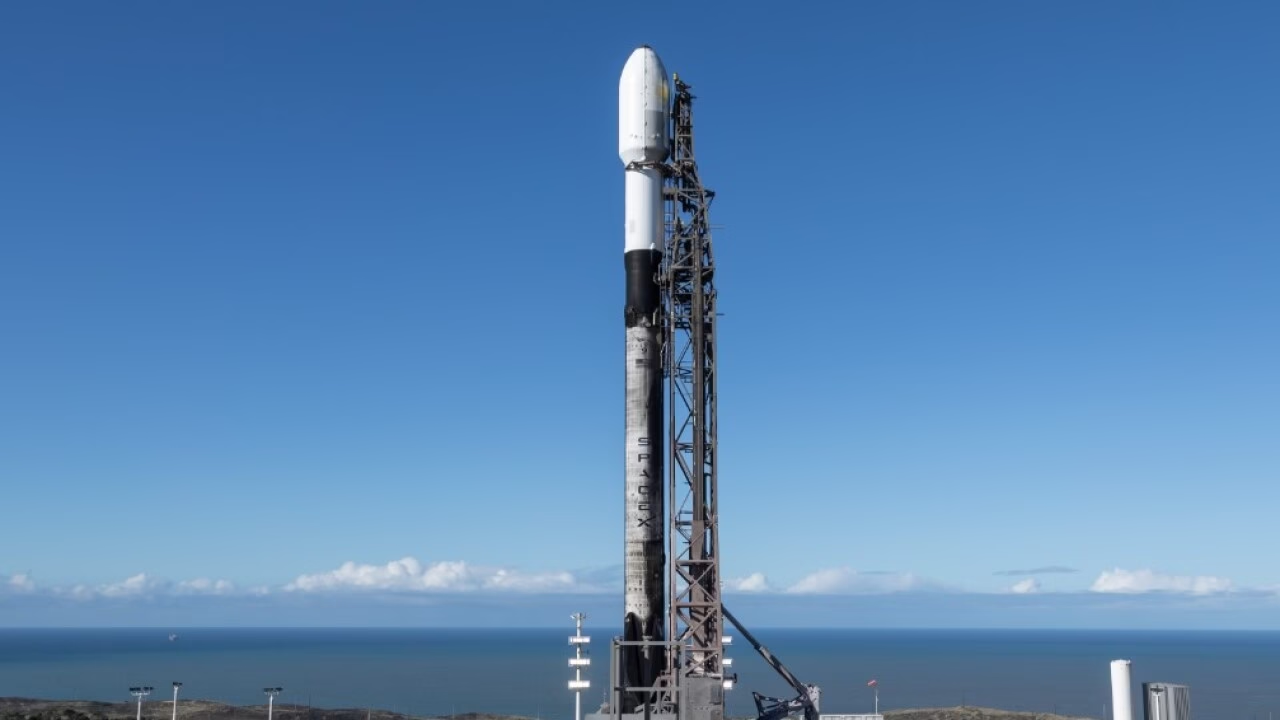
SpaceX launch has been postponed what was expected to be its final rocket launch of 2025 from the West Coast, underscoring both the complexity and the commercial importance of modern space operations. The mission, originally scheduled for Saturday evening from Vandenberg Space Force Base in California, is now expected to take place on Sunday following a delay caused by a ground systems issue.
While launch delays are common in the space industry, this mission carries particular significance—not just for SpaceX, but also for international partners, government agencies, and investors closely watching the rapidly growing space economy.
A Mission With International Importance
The postponed launch involves SpaceX’s Falcon 9 rocket carrying the COSMO-SkyMed Second Generation satellite, known as CSG-FM3. The satellite is part of an Earth-observation system developed for the Italian Space Agency in partnership with Italy’s Ministry of Defense.
This satellite will serve both civilian and military needs, including environmental monitoring, disaster management, land mapping, maritime surveillance, and national security. Data from the satellite will also be shared publicly through the European Space Agency, expanding its value beyond Italy.
For SpaceX, this mission represents another example of how the company has moved beyond launching its own Starlink satellites to becoming a preferred launch provider for governments around the world.
Why This Launch Matters for SpaceX’s Business
From a financial and business perspective, this launch highlights several key themes shaping SpaceX’s position in the global space market:
- Government Contracts Drive Stable Revenue
Launching satellites for foreign governments provides SpaceX with predictable, high-value contracts. These deals are less volatile than commercial launches tied to startups or experimental technologies. Serving agencies like the Italian Space Agency strengthens SpaceX’s reputation as a reliable partner for national missions. - Reusable Rockets Reduce Costs
The Falcon 9 rocket used for this mission has already flown 20 times and is attempting its 21st flight. Reusing rockets is central to SpaceX’s cost advantage. Every successful reuse lowers the average cost per launch, helping SpaceX undercut competitors while maintaining margins. - Operational Scale Sets SpaceX Apart
This would have been SpaceX’s seventh launch from Vandenberg this month alone. No other launch provider operates at this scale or frequency. High launch cadence signals operational maturity and reinforces SpaceX’s dominance in the market.
The Delay: A Normal Risk in a High-Value Industry
The launch was delayed due to a ground systems issue at the launch pad. Importantly, there was no reported problem with the rocket itself or the satellite payload.
In the space industry, delays are not considered failures. Weather, technical checks, and safety reviews frequently push launches back by hours or days. From a business standpoint, postponing a launch is often the more responsible—and less costly—decision than rushing and risking equipment worth hundreds of millions of dollars.
For investors and partners, such caution reinforces trust in SpaceX’s risk management practices.
Sonic Booms and Local Impact
If the launch proceeds on Sunday evening as planned, residents near Vandenberg Space Force Base may hear a sonic boom. This occurs when the Falcon 9’s first stage returns to land at Landing Zone 4 roughly eight minutes after liftoff.
While the sonic boom is brief, its predictability reflects SpaceX’s precision. Controlled landings close to the launch site reduce recovery costs and speed up refurbishment, further improving the economics of reusable rockets.
This will also mark the 31st landing at Landing Zone 4, adding to SpaceX’s long track record of successful booster recoveries.
Limited Visibility, But Strong Symbolism
Due to the rocket’s planned southern flight path, the launch may not be easily visible from neighboring states such as Arizona. However, visibility is less important than what the mission represents.
This launch is a symbol of SpaceX’s transition from a disruptive newcomer to a cornerstone of global space infrastructure. The company is now deeply embedded in national security, climate monitoring, and international cooperation.
The Satellite’s Economic Value
The COSMO-SkyMed Second Generation satellites are designed to operate in all weather conditions and at all times of day. Their ability to collect data regardless of cloud cover or darkness makes them especially valuable for:
- Emergency response after natural disasters
- Monitoring agriculture and food supply chains
- Managing forests and natural resources
- Supporting defense and maritime security
- Improving urban planning and land use
This wide range of applications increases the satellite’s return on investment for Italy and its partners. For SpaceX, successfully deploying such satellites strengthens its role in enabling data-driven decision-making across industries.
A Competitive Advantage Over Rivals
SpaceX’s main competitors—such as Arianespace, Blue Origin, and United Launch Alliance—operate fewer launches per year and often rely on fully expendable rockets or less proven reusable systems.
By contrast, SpaceX’s Falcon 9 has become the workhorse of the global launch market. Its reliability, combined with lower costs, has made it the default choice for many customers.
This competitive edge is not just technological; it is financial. Lower launch costs allow customers to deploy more satellites, upgrade systems faster, and justify larger constellations. That, in turn, drives more demand for launches—creating a reinforcing cycle that benefits SpaceX.
Closing Out 2025 on a Strong Note
Although delayed, this mission still marks the closing chapter of an extremely active year for SpaceX. In 2025, the company continued to expand its Starlink network, supported government missions, and maintained a rapid launch schedule unmatched by any competitor.
Even with occasional delays, SpaceX’s consistency has reshaped expectations in the aerospace industry. What once took years to schedule now happens weekly—or even daily.
Looking Ahead
Once launched, the satellite will be deployed approximately 17 minutes after liftoff into a polar orbit designed for global Earth observation. It will become the third satellite in Italy’s second-generation COSMO-SkyMed constellation, with a fourth already planned.
For SpaceX, this mission reinforces three core strengths: operational reliability, cost efficiency, and international trust. These strengths are why governments and institutions continue to choose SpaceX, even as competition increases.
Final Takeaway for Investors and Business Watchers
This postponed Falcon 9 launch is not just a space story—it is a business story. It reflects how SpaceX manages risk, delivers value to government clients, and maintains its leadership in a fast-growing industry.
Delays may grab headlines, but consistency builds companies. And as SpaceX prepares to send another high-value satellite into orbit, it continues to demonstrate why it remains one of the most influential private players in the global space economy.