
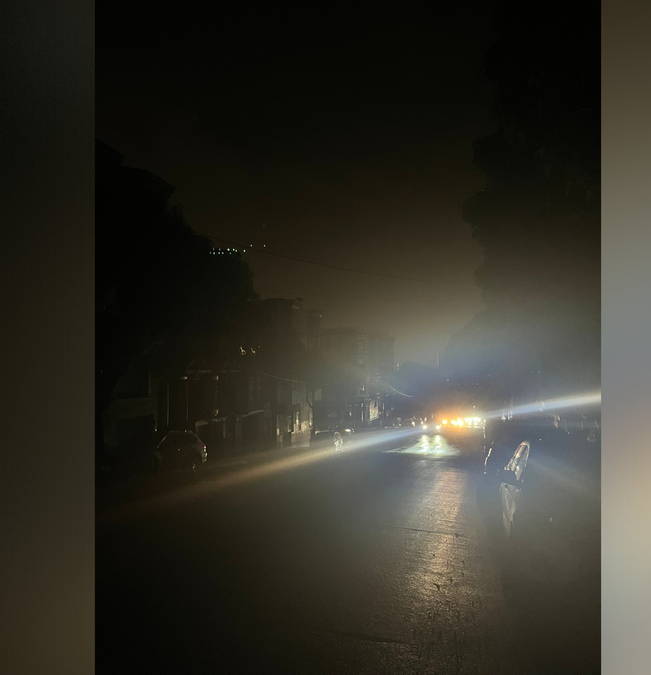
A major power outage plunged large parts of San Francisco into darkness on Saturday, December 20, 2025, cutting electricity to nearly 130,000 homes and businesses. The blackout affected roughly one-third of the city’s customers served by Pacific Gas and Electric Company (PG&E), making it one of the most disruptive power failures the city has seen in recent years.
The outage began in the early afternoon and initially affected neighborhoods in the northern part of the city, including Richmond, Presidio, and areas surrounding Golden Gate Park. Over the next few hours, the blackout expanded, leaving traffic signals, businesses, and public transport systems struggling to operate.
Widespread Impact Across the City
As electricity went out, restaurants, retail stores, and small businesses were forced to shut down without warning. Social media users shared images of darkened streets, closed shops, and Christmas decorations switched off just days before the holiday season. For many businesses, especially those dependent on weekend foot traffic, the outage meant lost revenue during an important shopping period.
Streetlights and traffic signals also failed in many areas, increasing safety concerns. The San Francisco Department of Emergency Management warned residents of significant citywide transit disruptions and urged people to avoid nonessential travel. Drivers were advised to treat non-working traffic signals as four-way stops to prevent accidents.
Public Transport Disruptions
The power failure did not stop at homes and businesses. Public transportation systems were also affected. City transportation agencies confirmed that some Muni bus routes and BART train stations were being bypassed due to the outage. Commuters faced delays, rerouted services, and unexpected disruptions, adding to the frustration during a busy weekend.
Transit interruptions have a ripple effect on the local economy. When workers cannot reach their jobs and customers cannot access businesses, productivity drops. For a city like San Francisco, where public transport is essential to daily life, power outages quickly translate into economic losses.
Cause Linked to Substation Fire
Initially, PG&E did not comment on the cause of the outage. However, later updates from fire officials revealed that at least some of the blackouts were linked to a fire inside a PG&E substation located at 8th and Mission streets. The fire was reported at approximately 3:15 pm, according to posts from emergency officials.
Substations play a critical role in distributing electricity across the city. Even a localized incident can disrupt power supply across large areas, as electricity networks are tightly connected. The incident raised fresh concerns about the resilience of urban power infrastructure, particularly in dense cities with aging systems.
PG&E Response and Restoration Uncertainty
By around 4 pm, PG&E announced on social media that it had stabilized the power grid and was not expecting additional outages. However, the company said it could not immediately confirm when full power restoration would be completed later that day.
The lack of a clear restoration timeline added to uncertainty for residents and business owners. For many restaurants, grocery stores, and service providers, prolonged outages can result in spoiled inventory, cancelled reservations, and lost wages for employees.
Economic Consequences of Large Power Outages
While power outages are often viewed as temporary inconveniences, their economic impact can be significant. In San Francisco, a city driven by services, tourism, retail, and technology, even a few hours without electricity can cost millions of dollars in lost activity.
Small businesses are especially vulnerable. Many lack backup generators and depend entirely on continuous power for payment systems, lighting, refrigeration, and security. When outages strike during peak hours, losses are immediate and difficult to recover.
There are also indirect financial effects. Traffic congestion increases fuel costs, public safety resources are stretched, and emergency services face higher demand. Insurance claims related to damaged equipment or spoiled goods may rise following major outages.
Infrastructure and Investor Concerns
Events like this also raise broader questions for investors and policymakers. Power reliability is a key factor in business confidence. Repeated or large-scale outages can influence decisions about where companies choose to operate or expand.
Utility providers like PG&E face ongoing scrutiny over infrastructure maintenance, safety standards, and investment in grid modernization. Incidents involving fires, substations, or prolonged outages often bring renewed attention to the costs required to upgrade aging power systems.
For financial markets, such events can affect utility stocks, insurance exposure, and public spending priorities. While a single outage may not move markets dramatically, repeated incidents contribute to long-term risk assessments.
Holiday Timing Adds Pressure
The timing of the outage, just days before Christmas, amplified its impact. The holiday season is one of the busiest periods for retailers and restaurants. Power failures during this time can disrupt sales, deliveries, and customer plans, adding stress to an already demanding period for businesses.
Residents also faced inconvenience at home, from disrupted heating and cooking to internet and mobile service interruptions. For families preparing for holiday gatherings, the outage added unexpected challenges.
Looking Ahead
As of Saturday evening, PG&E continued restoration efforts while city officials monitored transit and safety conditions. The incident serves as a reminder of how deeply modern urban life depends on reliable electricity — not just for comfort, but for economic stability and public safety.
For San Francisco, the outage highlights the importance of investing in resilient infrastructure, improving emergency communication, and ensuring faster response times when failures occur. For businesses and residents alike, it underscores the value of preparedness in an increasingly unpredictable environment.
While power was expected to gradually return, the broader conversation about grid reliability, infrastructure investment, and economic resilience is likely to continue long after the lights come back on.