


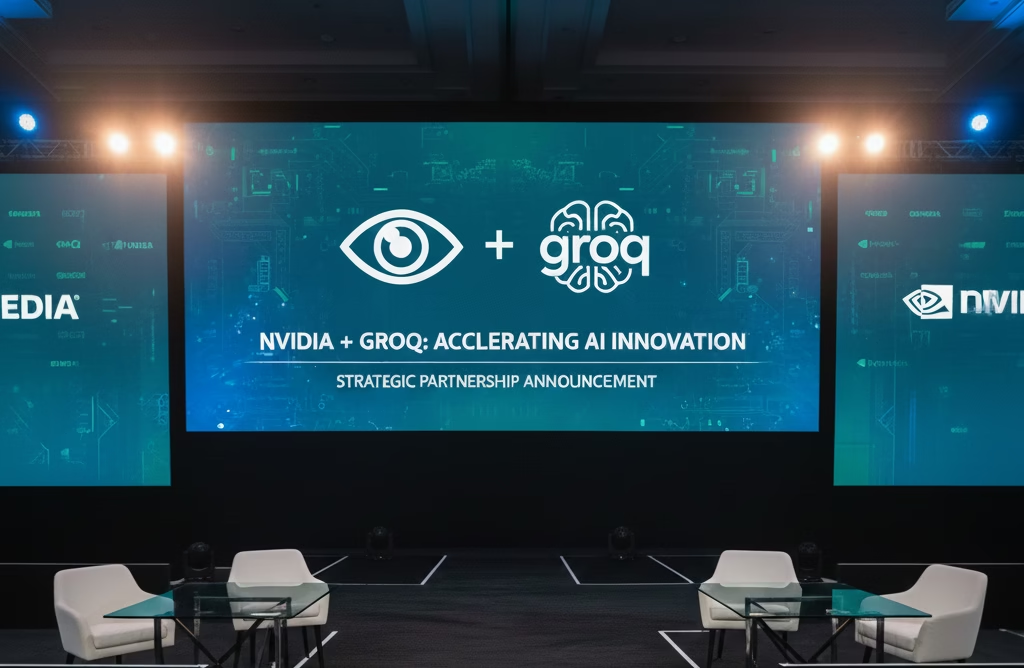
Nvidia Groq Deal once again shown why its massive balance sheet is one of its biggest competitive advantages in the global artificial intelligence race.
This week, the AI chip leader announced a non-exclusive licensing deal with startup Groq (GROQ.PVT), alongside the hiring of Groq’s founder and CEO Jonathan Ross, its president, and several other key employees. While Nvidia did not confirm the value of the agreement, CNBC reported the deal could be worth as much as $20 billion, making it Nvidia’s largest transaction to date.
Analysts say the move highlights how Nvidia (NVDA) is increasingly using its huge cash reserves to defend its leadership position, especially as competition heats up in parts of the AI chip market.
Bernstein analyst Stacy Rasgon described the Groq deal as “strategic,” noting that Nvidia is leveraging its rapidly growing cash flow to stay ahead in areas that could threaten its dominance. Nvidia generated $22 billion in cash in its most recent quarter, a jump of more than 30% from the year before.
Some market watchers see the deal as something closer to an acquisition than a simple partnership. Analysts at Hedgeye Risk Management argued that Nvidia is effectively absorbing Groq’s technology and talent without formally buying the company, potentially reducing regulatory scrutiny that often comes with large takeovers.
Nvidia’s Growing Web of AI Investments
The Groq deal is just the latest in a long list of investments and partnerships made by Nvidia, now the world’s first publicly listed company valued at $5 trillion.
Over the years, Nvidia has backed companies across the AI ecosystem. These include developers of large AI models such as OpenAI and xAI, as well as cloud-style AI infrastructure firms like CoreWeave and Lambda, which provide computing power to businesses. In some cases, these firms also compete with Nvidia’s biggest customers, including major cloud providers.
Nvidia has also invested in other chipmakers such as Intel and Enfabrica. In 2020, it attempted to acquire British chip designer Arm, a deal that ultimately failed due to regulatory opposition.
Because many of Nvidia’s investments involve its own customers, critics have accused the company of creating a closed financial loop similar to what existed during the dot-com bubble. Nvidia has strongly rejected those claims, saying its investments are meant to support innovation and expand the AI market as a whole.
Why Groq Matters
Groq was founded in 2016 with the goal of challenging Nvidia’s grip on AI chips. Instead of graphics processing units (GPUs), which Nvidia dominates, Groq develops chips called language processing units, or LPUs.
AI computing is generally split into two stages. The first is training, where AI models learn from massive amounts of data. The second is inference, where trained models are used to generate answers, images, or predictions. Both stages require large amounts of computing power, but they have different needs.
Nvidia’s GPUs are widely considered the gold standard for training large AI models. However, some analysts believe the company could face more competition in inference, where custom-built chips may offer advantages for specific tasks.
Groq argues that its LPUs are faster and more energy-efficient for certain inference workloads. One reason is that Groq’s chips rely heavily on on-chip memory, which can speed up calculations and reduce power use. Nvidia’s GPUs, by contrast, depend more on external memory supplied by companies like Micron and Samsung.
Jonathan Ross, before joining Nvidia, said Groq’s long-term goal was to provide chips for half of the world’s AI inference needs at a much lower cost. He previously led the development of Google’s first in-house AI chips, making him a proven competitor in this space.
Mixed Reactions on Wall Street
Some analysts believe Nvidia’s move strengthens its position even further. Cantor Fitzgerald analyst CJ Muse said the combination of licensing Groq’s technology and hiring its leadership allows Nvidia to play both offense and defense. According to Muse, the deal could help Nvidia gain an even larger share of the inference market.
Others are more cautious. Analysts at Hedgeye and DA Davidson questioned whether Groq’s technology is ready for large-scale AI workloads, pointing to limitations in memory capacity. They argue that Groq’s chips may only be useful for a narrow set of applications.
Despite the debate, Nvidia shares rose about 1% following news of the deal, suggesting investors remain confident in the company’s strategy.
My Analysis: A Defensive Move From a Position of Strength
This deal is less about Groq today and more about Nvidia tomorrow.
Nvidia does not need Groq to survive. What it needs is to remove future threats before they grow. By licensing Groq’s technology and bringing its leadership in-house, Nvidia gains insight into a competing chip design while preventing that design from becoming a serious rival.
Just as important, Nvidia is sending a clear message to the market: if a promising alternative emerges, Nvidia has the cash to neutralize it early.
The reported $20 billion price tag may seem high, but for a company generating tens of billions in cash each quarter, it is a manageable cost to protect long-term dominance. Investors should view this as a strategic insurance policy rather than a risky bet.
However, the move also highlights a broader concern. Nvidia’s growing influence across AI software, hardware, and infrastructure could eventually attract tougher regulatory scrutiny. While this deal avoids a formal acquisition, repeated moves like this may still draw attention from regulators over time.
For now, Nvidia remains firmly in control. The Groq deal reinforces the idea that in the AI race, financial strength is just as powerful as technical innovation.