


Paramount has dramatically escalated its hostile takeover attempt of Warner Bros. Discovery (WBD), betting that the personal fortune of one of the world’s richest men can finally break the deal’s deadlock.
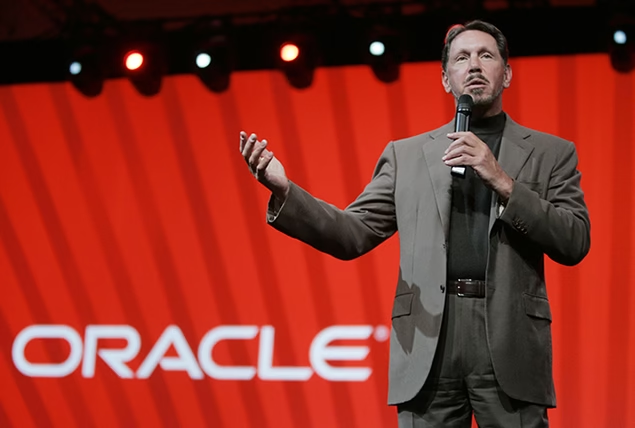
On Monday, Paramount announced that Oracle founder Larry Ellison will personally guarantee $40.4 billion of the equity financing behind Paramount’s proposed acquisition of Warner Bros. Discovery. This move is aimed squarely at countering repeated criticism from WBD’s board, which has questioned whether Paramount’s financing is real, reliable, and capable of closing.
Despite the high-profile guarantee, Paramount did not raise its offer price. The company continues to offer $30 per share, all cash, valuing the deal at roughly $78 billion, with an enterprise value of about $108 billion when debt is included.
Warner Bros. Discovery’s board has already rejected Paramount’s bid several times and has instead agreed to a competing transaction with Netflix. That deal, which values WBD’s core studio and streaming assets at roughly $83 billion, excludes many of WBD’s traditional cable networks and is structured differently. Paramount argues that its proposal is superior. WBD strongly disagrees.
With this latest move, the fight is no longer just between media companies. It is now a public showdown involving billionaires, sovereign wealth funds, regulators, and shareholders — all with very different ideas about value, risk, and the future of entertainment.
Why Larry Ellison’s Guarantee Matters
At the center of Paramount’s revised bid is Larry Ellison, the 80-year-old founder of Oracle and father of Paramount CEO David Ellison. With a net worth estimated at around $250 billion, Ellison is one of the wealthiest people on the planet.
Under the amended offer, Ellison has agreed to:
- Personally guarantee $40.4 billion of the equity financing for the deal
- Cover any damages claims if the transaction fails
- Not revoke or restructure the Ellison family trust during the deal process
- Allow public disclosure of trust records showing ownership of approximately 1.16 billion Oracle shares
These steps directly address concerns raised by WBD’s board, which had described Paramount’s financing as “illusory” and suggested the deal might collapse before closing.
WBD Chairman Samuel Di Piazza previously said the board was not confident Ellison would remain fully committed through closing. “Doing a deal is great,” he said in a CNBC interview last week. “Closing a deal is better.”
Paramount’s response is essentially: If Larry Ellison’s money isn’t good enough, what is?
By putting his personal wealth on the line — roughly one-sixth of his net worth — Ellison is sending a strong signal that he intends to see the deal through.
Paramount Sweetens the Breakup Fee, But Not the Price
In addition to Ellison’s guarantee, Paramount also increased its reverse breakup fee to $5.8 billion, up from $5 billion. This fee would be paid to WBD shareholders if Paramount fails to close the deal.
The increase brings Paramount’s breakup fee in line with Netflix’s offer, removing another objection raised by WBD’s board.
Still, Paramount stopped short of what many investors expected: raising the bid price.
The company continues to offer $30 per share, compared with Netflix’s $27.75 per share offer. On the surface, Paramount’s price looks higher. But WBD and Netflix argue that the Netflix deal ultimately delivers more value because of how it restructures the company.
Netflix plans to acquire WBD’s studio and streaming businesses — including Warner Bros., HBO, and HBO Max — while spinning off the cable networks like CNN and TNT into a separate entity. WBD’s board believes this structure unlocks more long-term value than selling everything outright to Paramount.
Paramount, on the other hand, wants to buy all of WBD, including the declining cable channels. It argues that full ownership creates strategic advantages and avoids the uncertainty of a spinoff.
This disagreement over structure — not just price — sits at the heart of the standoff.
A Deal Funded by Global Wealth
One of the more controversial aspects of Paramount’s bid is its financing mix.
While Larry Ellison is guaranteeing a large portion of the equity, Paramount is also relying heavily on funding from the royal families of Saudi Arabia, Qatar, and Abu Dhabi. These sovereign investors bring deep pockets, but they also raise questions about influence, governance, and long-term intentions.
WBD’s board has publicly questioned why Larry Ellison, given his enormous wealth, needs such extensive outside backing at all.
Paramount executives have brushed off those concerns. David Ellison has described WBD’s skepticism as “absurd” and insists the financing is “airtight.”
RedBird Capital Partners, a key investor in Paramount Skydance, has also committed significant funds to the transaction. RedBird founder Gerry Cardinale said Monday that the amended offer “clears the brush of obfuscation” around Paramount’s financing.
In other words, Paramount believes it has now removed every excuse for WBD’s board to keep saying no.
The Board vs. the Shareholders
Despite Paramount’s efforts, it remains unclear whether WBD’s board will reconsider its position.
The board has a legal duty to act in what it believes is the best interest of shareholders. So far, it has concluded that Netflix’s deal offers greater certainty and long-term value, even if the headline price per share is lower.
But Paramount’s bid is hostile, meaning it is appealing directly to shareholders rather than working cooperatively with the board.
That distinction matters.
If enough WBD shareholders believe Paramount’s offer is better — especially now that Larry Ellison has personally guaranteed the financing — they could pressure the board to reconsider or even vote against its recommendation.
Cardinale made this argument bluntly in a CNBC interview Monday.
“At the end of the day, the shareholders own this company,” he said. “The board doesn’t own it. David Zaslav doesn’t own this company.”
This framing sets up a potential showdown where the board’s judgment clashes with shareholder sentiment.
Regulatory Concerns Add Another Layer of Risk
Beyond financing and valuation, regulatory approval looms as a major wildcard.
Paramount has argued that Netflix’s acquisition of WBD’s streaming and studio assets would reduce competition by combining two massive platforms under one roof. According to Paramount, a merged Netflix-HBO Max entity would control roughly 420 million subscribers worldwide, creating enormous pricing power.
Cardinale has warned that such concentration is alarming not just for regulators, but also for creators, talent, and theater owners.
Netflix executives disagree. Co-CEOs Ted Sarandos and Greg Peters have said they are confident their deal will pass regulatory review. Sarandos has also promised to preserve WBD’s theatrical release strategy and protect jobs during a period of widespread industry layoffs.
Regulators have not yet weighed in publicly, but any transaction of this size will face intense scrutiny — especially in an election year and amid growing concerns about media consolidation.
How the Market Reacted
Investors responded positively, though cautiously, to Paramount’s announcement.
- Warner Bros. Discovery shares rose about 3–4% on Monday
- Paramount shares gained between 3% and 7%, depending on the trading session
- Netflix shares were largely flat, reflecting investor confidence that its deal remains on track
The market reaction suggests that investors see Paramount’s revised offer as more credible than before — but not necessarily as a guaranteed winner.
What Happens Next?
Warner Bros. Discovery’s board is expected to formally respond to Paramount’s amended bid in the coming days or weeks.
Because the changes address some — but not all — of the board’s stated concerns, a reversal is far from certain. Paramount has improved the credibility of its offer without improving its economics.
That leaves the final outcome resting on three key forces:
- Shareholders, who may be tempted by a higher cash offer
- Regulators, who could complicate or block either deal
- Time, which tends to favor the bidder with fewer moving parts
For now, Paramount has made its boldest move yet. By putting Larry Ellison’s personal fortune behind the bid, the company has turned what once looked like a speculative challenge into a serious test of WBD’s boardroom resolve.
Whether that will be enough remains an open question — but one thing is clear: this takeover battle is far from over.