
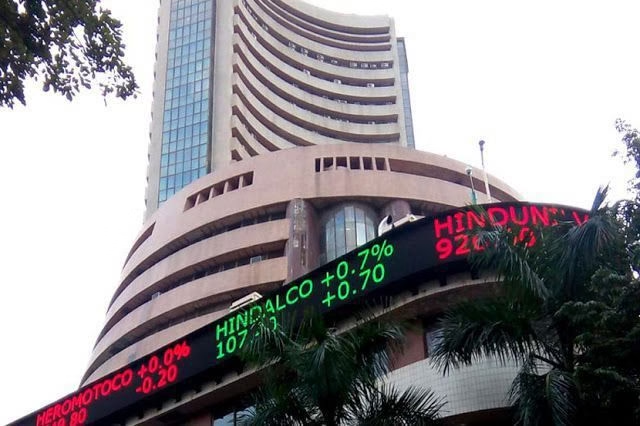
Indian Share Market is expected to open higher on Tuesday, supported by growing optimism around corporate earnings and improving business activity. Investors are closely watching quarterly updates from major companies, hoping for confirmation that earnings growth is regaining momentum after a mixed start to the year.
Early signals from the derivatives market point to a positive opening. Gift Nifty futures were trading around 26,404.5 as of early morning, indicating that the Nifty 50 (.NSEI) could start above Monday’s closing level of 26,250.30. The benchmark index touched a record high during Monday’s session but later slipped by 0.3%, weighed down mainly by losses in information technology stocks.
While the near-term outlook remains constructive, gains may be limited. Indian benchmarks are already trading close to all-time highs, and investors remain cautious due to rising global trade tensions—particularly those involving the United States.
Trade Tensions Cast a Shadow
Market sentiment turned cautious on Monday after U.S. President Donald Trump warned that tariffs on Indian goods could be raised further if India does not reduce its purchases of Russian oil. The U.S. has already imposed tariffs of up to 50% on certain Indian exports, with half of those duties specifically linked to India’s continued imports of Russian crude.
These developments have increased uncertainty for export-oriented sectors such as IT services, engineering goods, and specialty chemicals. Any escalation in tariffs could pressure margins and dampen investor confidence, especially in stocks that depend heavily on the U.S. market.
Stocks to Watch: Banks and Consumer Names in Focus
Several large companies are expected to remain in focus following their quarterly business updates.
Major private lenders including HDFC Bank, Axis Bank, Kotak Mahindra Bank, and IndusInd Bank reported improved loan growth during the December quarter. This points to a recovery in credit demand and suggests that businesses and consumers are becoming more confident about spending and expansion. A healthy banking sector is often seen as a strong indicator of broader economic stability.
In the consumer space, Trent, a leading clothing retailer, reported 17% growth in standalone revenue during the December quarter. While this marks a recovery from the previous quarter—when growth slowed to its weakest pace in four years—it also highlights that consumer demand is gradually improving rather than surging.
Meanwhile, Dabur India signaled early signs of recovery in the fast-moving consumer goods segment. Demand had softened earlier as consumers delayed purchases ahead of government tax cuts introduced in September. With those changes now in effect, spending appears to be picking up slowly, especially in urban areas.
What India’s Market Means for Global and U.S. Investors
India’s stock market is no longer just a domestic story—it has become an important part of the global investment landscape. As the world’s fastest-growing major economy, India plays a key role in shaping global growth expectations.
When Indian markets perform well, it sends a positive signal to global investors about demand in emerging economies. Strong loan growth, rising consumer spending, and stable corporate earnings suggest that India can continue to act as a growth engine at a time when many developed economies are slowing.
For U.S. markets, India’s performance matters in several ways. Many American companies have deep business ties with India, either through technology services, manufacturing partnerships, or consumer markets. A stable and growing Indian economy supports revenue growth for U.S. firms with global exposure.
However, trade tensions between the U.S. and India could introduce volatility. Higher tariffs may disrupt supply chains, increase costs, and weigh on investor sentiment on both sides. If trade disputes escalate, U.S. markets—already sensitive to inflation and policy uncertainty—could see increased swings.
Outlook: Optimism with Caution
In the short term, Indian equities are supported by improving earnings trends, resilient banking performance, and early signs of consumer recovery. These factors make India attractive to global investors looking for growth.
At the same time, high valuations and geopolitical risks mean markets are unlikely to move in a straight line. Investors will continue to balance strong domestic fundamentals against global trade pressures and policy uncertainty.
For now, India remains a bright spot in global markets—but the path ahead will depend on how well earnings growth holds up and whether trade tensions ease or intensify.
Read also:
XRP Price Surge 2026: ETF Inflows, Supply Tightens, Outlook Ahead
Broadcom (AVGO) Beat Nvidia in 2025: Buy, Sell, or Hold in 2026?
Exxon Mobil Stock (XOM) Surges After Trump Hints at Venezuela Oil Control
Global Markets React Cautiously After US Captures Venezuela’s President