Why Greenland Tariff Threats Are Driving Gold and Silver Prices Higher
Gold and silver prices surged to fresh record highs as escalating geopolitical tensions between the United States and Europe drove investors toward safe-haven assets. The rally was triggered by U.S. President Donald Trump’s renewed push to acquire Greenland, accompanied by sweeping tariff threats against European nations that oppose the plan.
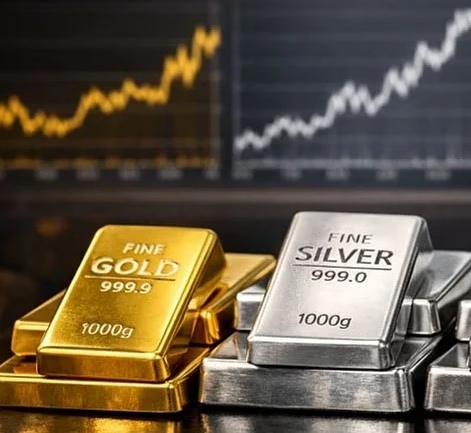
Spot gold climbed as much as 2.1% to nearly $4,700 per ounce, while silver jumped more than 4%, touching levels close to $94 per ounce. The move marks one of the strongest periods for precious metals in modern history, reflecting deepening concerns over trade wars, currency weakness, and political interference in monetary policy.
Greenland Tensions Spark Trade War Fears
The catalyst behind the market move is Washington’s plan to impose tariffs on eight European countries, including France, Germany, and the UK. Under the proposal, the U.S. will introduce 10% import tariffs starting February 1, which will rise to 25% in June if no agreement is reached over Greenland.
European leaders are already preparing countermeasures. Officials familiar with the talks say the European Union is considering retaliatory tariffs worth €93 billion ($108 billion) on U.S. goods. Germany’s Finance Minister Lars Klingbeil described the situation as an escalation that Europe can no longer ignore, warning that “the limit has been reached.”
Market participants see the standoff as a major threat to global trade, economic growth, and financial stability.
Investors Rush to Safe Havens
Whenever global uncertainty rises, investors tend to reduce exposure to risky assets like stocks and move into perceived stores of value. Gold and silver have historically played that role, and the current environment has reinforced their appeal.
The U.S. dollar weakened amid the turmoil, further boosting precious metals, which are priced in dollars. A softer dollar makes gold and silver cheaper for international buyers, increasing demand.
Exchange-traded funds (ETFs) backed by gold also saw a surge in inflows. Holdings rose by more than 28 metric tons in a single week, the largest increase since September, highlighting strong institutional participation.
A Historic Rally in Precious Metals
Gold’s rise has been nothing short of remarkable. Prices are now up roughly 70% over the past 12 months, marking the metal’s best annual performance since 1979. Silver has performed even more dramatically, with prices tripling over the past year.
Several long-term factors have supported the rally:
- Falling U.S. interest rates, which reduce the opportunity cost of holding gold
- Strong buying by global central banks seeking to diversify away from the U.S. dollar
- Ongoing geopolitical conflicts, including Ukraine and the Middle East
- Rising concerns over political pressure on central banks
The Trump administration’s renewed criticism of the Federal Reserve has added another layer of uncertainty. Investors are closely watching an upcoming U.S. Supreme Court hearing related to Trump’s effort to remove Fed Governor Lisa Cook, which could have implications for the central bank’s independence.
Analysts See Further Upside
Many market analysts believe the rally still has room to run. Citigroup recently forecast that gold could reach $5,000 per ounce within three months, while silver could surge to $100 per ounce.
Asset managers argue that strong fundamentals remain in place. With real interest rates likely to fall and central banks continuing to increase gold reserves, sharp declines appear unlikely in the near term.
At current price levels, mining companies are also expected to see margins that are four to five times higher than in 2024, further supporting investor confidence in the sector.
Impact on Global Markets
While precious metals soared, equity markets reacted negatively. European shares declined, particularly in sectors most exposed to trade disruptions. Automakers and luxury goods companies led losses, with key indices falling between 2% and 3%.
Asian markets also slipped as investors assessed the broader implications of escalating U.S. trade actions, which follow recent tensions involving Venezuela and Iran.
Meanwhile, other metals such as copper also gained, though their strength was driven more by long-term demand from energy infrastructure and data centers rather than geopolitics.
Simple Analysis: What This Means for Investors
The surge in gold and silver prices is not driven by hype, it reflects growing discomfort with global politics and economic direction.
At its core, this rally tells us three things:
- Confidence in traditional systems is weakening
Concerns about trade wars and central bank independence are pushing investors to assets that do not rely on government credibility. - Geopolitical risk is becoming a long-term theme
This is not a single headline reaction. Ongoing conflicts and policy uncertainty are creating sustained demand for safe assets. - Precious metals are acting as insurance, not speculation
Investors are not just chasing returns; they are protecting purchasing power against inflation, currency swings, and policy shocks.
For everyday investors, this does not necessarily mean going “all-in” on gold or silver. But it does highlight why precious metals continue to play a role in diversified portfolios during periods of instability.
If geopolitical tensions ease, prices may cool. However, as long as trade threats, political pressure on institutions, and global conflicts persist, gold and silver are likely to remain well supported.
Read also:
EU Plans €93 Billion Tariffs on US Over Trump’s Greenland Threat
Bitcoin Drops Below $92,000 as Tariff Fears Trigger Crypto Selloff