
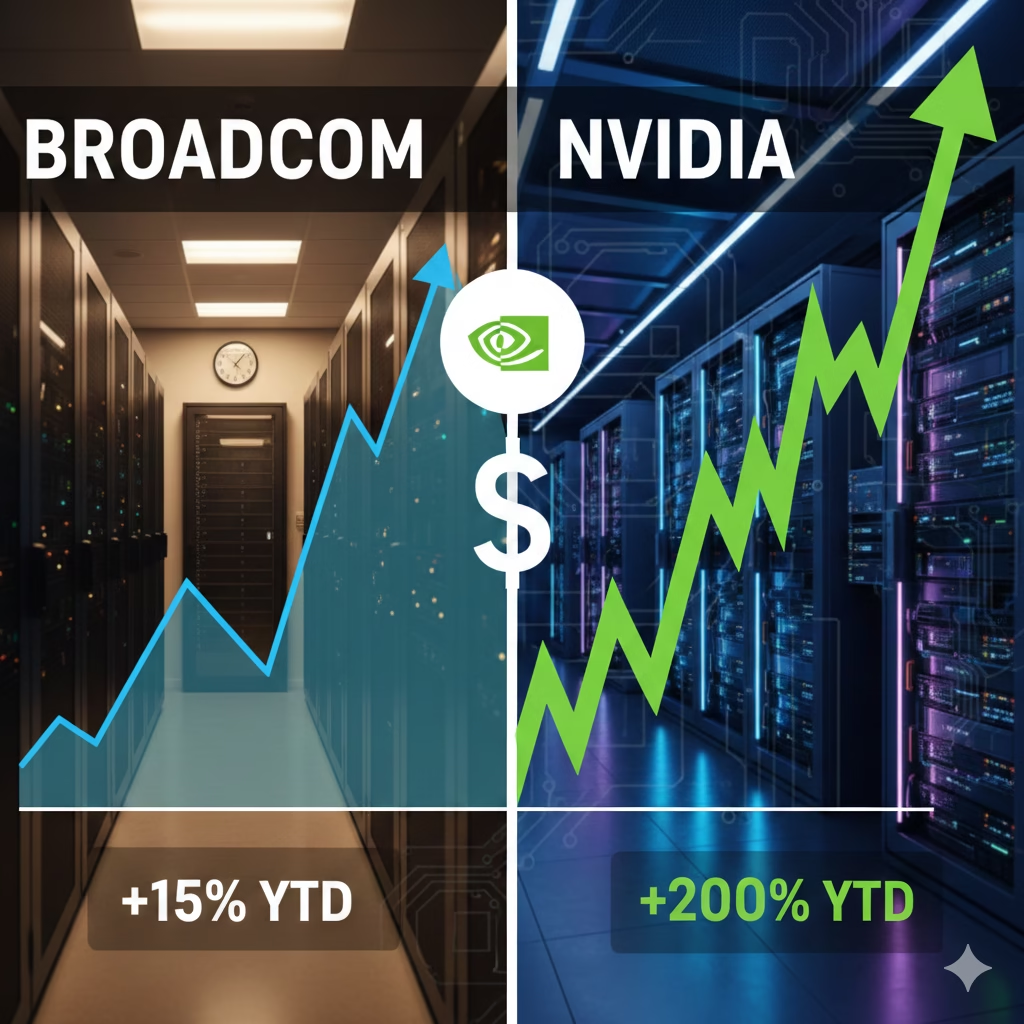
The artificial intelligence boom has reshaped the stock market, and few sectors have benefited more than semiconductors. While Nvidia has become the most famous AI stock in the world, it wasn’t the top performer in 2025. That title belongs to Broadcom (AVGO), a quieter but increasingly powerful player in the AI infrastructure space.
Broadcom’s stock rose about 50% in 2025, outperforming Nvidia’s roughly 36% gain. This outperformance has investors asking an important question as we enter 2026: Is Broadcom still worth buying, or has the easy money already been made?
To answer that, we need to look at how AI spending is evolving, where Broadcom fits into that picture, and whether its stock price already reflects the company’s bright future.
AI Spending Is Still in the Early Stages
Artificial intelligence models require enormous computing power. Training and running these systems happens inside massive data centers filled with thousands of specialized chips and networking equipment. Nvidia CEO Jensen Huang has estimated that global spending on AI-related data center infrastructure could reach $4 trillion by 2030.
That number alone explains why chipmakers are seeing explosive growth. Demand for AI hardware is still far greater than supply, and companies across the technology industry are racing to secure the chips they need to stay competitive.
Nvidia dominates this space with its graphics processing units (GPUs), which are widely considered the best all-purpose chips for AI workloads. But as AI systems become more advanced, some large developers are turning toward custom-built chips that are designed specifically for their needs. This shift has opened the door for Broadcom.
Why Big AI Players Are Turning to Broadcom
Nvidia’s GPUs are popular because they work well for many different applications. But they are not always the most efficient option for companies running very specific AI tasks at massive scale.
Broadcom specializes in designing custom AI accelerators, which are chips tailored to the exact requirements of individual customers. One of the best-known examples is Alphabet’s Tensor Processing Units (TPUs), which Broadcom helped design. These chips are now used to power Google’s Gemini AI models.
Recently, Alphabet began offering its newest “Ironwood” TPUs to outside developers, which is a major win for Broadcom as the designer and supplier behind the technology.
One of those customers is Anthropic, the AI startup behind the Claude chatbot. Anthropic placed a $10 billion order for Ironwood TPUs earlier this year and followed it with another $11 billion order, with deliveries planned through late 2026. Broadcom says Anthropic is just one of four large customers currently using its custom AI chips.
Networking: The Hidden Backbone of AI
Broadcom’s opportunity in AI goes beyond chips alone. AI systems rely on fast and reliable data movement between processors, storage, and memory. That’s where Broadcom’s networking equipment comes in.
Its Tomahawk Ethernet switches help manage how data flows inside data centers. These switches are known for their speed and low delay, which helps AI models run faster and more efficiently. As data centers grow larger and more complex, demand for this kind of networking hardware is rising sharply.
This combination of custom chips and networking gear places Broadcom at the heart of AI infrastructure, even if it doesn’t receive the same attention as Nvidia.
Broadcom’s Financial Growth Is Accelerating
Broadcom’s recent financial results show just how strong this AI-driven demand has become.
In the fourth quarter of fiscal 2025, the company generated $18 billion in revenue, beating its own forecast. That was a 28% increase from the same period a year earlier, marking the second straight quarter of accelerating growth.
AI-related semiconductor revenue jumped 74% year over year, reaching $6.5 billion. Even more impressive, Broadcom expects AI semiconductor revenue to climb to $8.2 billion in the first quarter of fiscal 2026, representing 100% growth.
Profit growth has been equally striking. Broadcom reported $8.5 billion in quarterly profit, nearly doubling from the previous year. For the full fiscal year, profit almost quadrupled to $23.1 billion.
These results are especially notable given Broadcom’s aggressive acquisition strategy between 2019 and 2023, when it spent nearly $100 billion buying businesses. Those deals weighed on earnings at the time, but today they are paying off.
Why Valuation Is the Biggest Risk
Despite its strong performance, Broadcom’s stock is no longer cheap.
Based on its 2025 earnings, the stock trades at a price-to-earnings ratio above 70, which is significantly higher than the broader technology market and even more expensive than Nvidia. On a sales basis, Broadcom’s valuation is nearly three times its historical average.
This high valuation reflects investor confidence in the company’s AI growth, but it also limits how much further the stock can rise in the short term. Even if Broadcom continues to execute perfectly, the stock may need time for earnings to “catch up” to its price.
Buy, Sell, or Hold for 2026?
For long-term investors, Broadcom remains a compelling company. Its role in AI infrastructure is growing, its customer base includes some of the world’s most powerful tech firms, and its business is more diversified than many chipmakers thanks to its software division.
However, for investors with a short time horizon, expectations should be realistic. After a near 700% gain over five years and a strong run in 2025, the stock may experience periods of slower growth or consolidation.
That makes Broadcom more suitable as a long-term hold or gradual accumulation, rather than a stock to chase for quick gains in 2026.
Nvidia vs. Broadcom: Two Different AI Bets
Nvidia offers more direct exposure to AI computing. Its GPUs remain the industry standard, and analysts remain overwhelmingly bullish on the stock, citing massive future order visibility and a powerful software ecosystem.
Broadcom, by contrast, offers a more balanced approach. Its revenue comes from custom AI chips, networking hardware, and software, making it less dependent on any single product cycle. Analysts expect AI-related revenue to surge again in 2026, with some forecasting earnings per share to exceed $10 next year.
Wall Street is optimistic about both stocks, but they serve different investor goals. Nvidia appeals to those seeking pure AI growth, while Broadcom suits investors looking for AI exposure combined with stability and diversification.
Final Analysis: What Investors Should Do
Broadcom did not outperform Nvidia by accident. Its success reflects a deeper shift in how AI infrastructure is being built, with customization and networking becoming just as important as raw computing power.
That said, valuation matters. At current prices, Broadcom stock assumes continued strong growth for several years. Long-term investors who believe AI spending will keep rising may still find value, especially on pullbacks. Short-term traders, however, may find better opportunities elsewhere.
Bottom line:
- Long-term investors: Hold or buy gradually
- Short-term investors: Be cautious
- Risk-averse investors: Broadcom offers a steadier alternative to Nvidia, but not at a bargain price
As AI reshapes the global economy, both Nvidia and Broadcom are likely to remain winners — just in very different ways.
Read also:
Exxon Mobil Stock (XOM) Surges After Trump Hints at Venezuela Oil Control
Global Markets React Cautiously After US Captures Venezuela’s President