


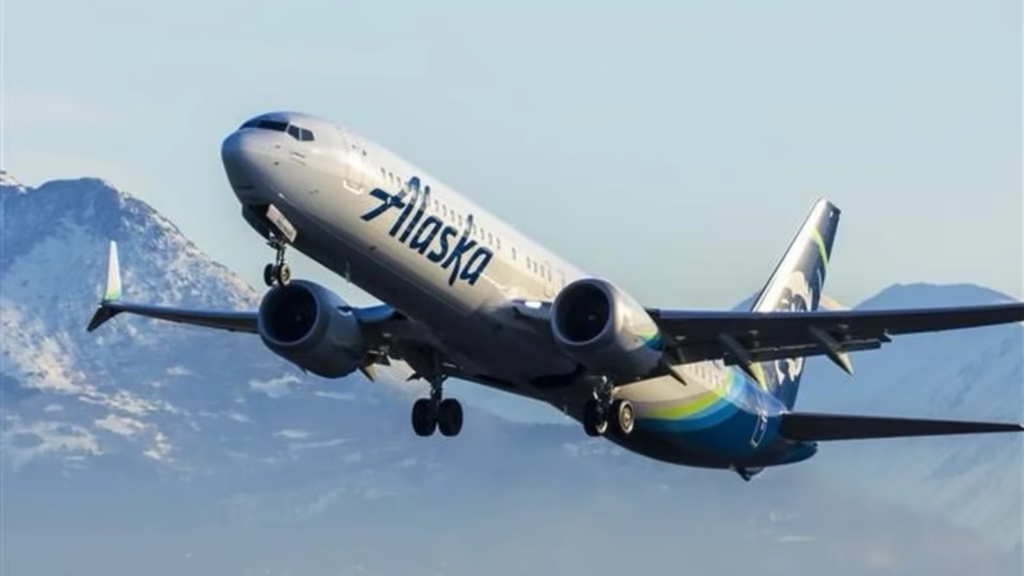
Alaska Airlines has announced the largest aircraft purchase in its history, placing an order for more than 100 Boeing jets in a move that underscores its long-term growth ambitions and renewed confidence in the U.S. plane maker. The deal includes 105 Boeing 737 MAX 10 aircraft and five Boeing 787-10 Dreamliners, marking a major milestone for both companies.
The order comes at a critical time for Boeing, which has been working to restore trust after a series of safety and production setbacks. For Alaska Airlines, the purchase is about more than fleet expansion—it is a strategic bet on future demand, efficiency, and international growth well into the 2030s.
Alaska’s Biggest Aircraft Order Ever
The newly announced purchase is Alaska Airlines’ largest single aircraft order to date. Of the 105 Boeing 737 MAX 10 planes, 53 are new purchases while 52 come from options the airline had previously secured. In addition, Alaska exercised earlier options to buy five wide-body Boeing 787-10 Dreamliners, which will support the carrier’s long-haul international plans.
The airline also confirmed that the agreement includes options for 35 additional 737 MAX 10 jets, giving it flexibility to expand further if market conditions remain favorable.
This order builds on Alaska’s existing commitments. Prior to the announcement, the airline had already ordered more than 40 MAX 10 aircraft. The new deal significantly strengthens its position in Boeing’s delivery queue at a time when aircraft availability is increasingly scarce.
A Vote of Confidence in Boeing
The timing of the order is noteworthy. It is Alaska Airlines’ first major Boeing purchase since a serious incident involving one of its aircraft in January 2024. During a flight departing Portland, Oregon, a door plug panel blew out of a Boeing 737 MAX 9 operated by Alaska Airlines shortly after takeoff. While no passengers suffered serious physical injuries, the incident shocked travelers and triggered renewed scrutiny of Boeing’s manufacturing processes.
Investigations later revealed that the aircraft had been delivered without key bolts installed in the door plug. The incident forced Boeing to slow production and address quality concerns, dealing another blow to a company already recovering from two fatal 737 MAX crashes in 2018 and 2019.
Against this backdrop, Alaska’s decision to place its largest-ever order is being widely seen as a strong endorsement of Boeing’s turnaround efforts.
Shane Jones, who oversees fleet planning and other key areas at Alaska Airlines, said the airline’s trust in Boeing was “part of this order.” He added that the purchase reflects confidence in both the certification of the MAX 10 and Boeing’s ability to deliver high-quality aircraft on time.
Betting on the 737 MAX 10
The bulk of the order centers on the Boeing 737 MAX 10, the largest variant in the MAX family. The aircraft is designed to carry more passengers than smaller single-aisle jets, making it particularly attractive for high-demand routes such as cross-country flights.
While the MAX 10 has a shorter range than some competing models, its seating capacity helps airlines lower costs per passenger, a key advantage in an industry where margins are often thin.
However, the MAX 10 has faced repeated delays and is still awaiting certification from U.S. regulators. The aircraft is years behind its original schedule, largely due to increased regulatory scrutiny following earlier MAX-related accidents.
Despite these uncertainties, Alaska Airlines expects certification to happen this year, with deliveries beginning in 2027. By placing the order now, the airline is effectively locking in production slots through the mid-2030s, ensuring access to new aircraft at a time when Boeing has more than 6,000 planes on backorder.
Supporting Domestic and International Expansion
Alaska Airlines says roughly half of the new aircraft will replace older planes in its fleet, while the rest will support growth. This balance reflects a dual strategy: modernizing operations while expanding capacity to meet future demand.
The five Boeing 787-10 Dreamliners will play a crucial role in the airline’s international ambitions. These wide-body jets are designed for long-haul routes and feature advanced aerodynamics, lightweight composite materials, and modern cabins that improve fuel efficiency and passenger comfort.
The Dreamliners will allow Alaska to expand service to Europe and Asia, complementing its existing network and building on the airline’s merger with Hawaiian Airlines in 2024. That merger significantly expanded Alaska’s reach across the Pacific and strengthened its position in long-distance travel markets.
According to the airline, the new aircraft could increase its total fleet to more than 475 planes by 2030 and over 550 by 2035, up from about 413 aircraft today.
Strengthening a Single-Manufacturer Strategy
Alaska Airlines has long favored a simplified fleet strategy, relying heavily on Boeing aircraft. This approach reduces training, maintenance, and operational complexity, helping keep costs under control.
The introduction of the 737 MAX 10 supports this strategy by offering higher capacity without requiring a shift to a different aircraft family. The plane’s efficiency and seating density are expected to deliver the lowest cost per seat among single-aisle jets in Alaska’s fleet.
Company leadership says this investment aligns with its “Alaska Accelerate” strategic plan, which focuses on steady, scalable, and sustainable growth.
Boeing’s Perspective
For Boeing, the Alaska Airlines deal is a significant win. Under CEO Kelly Ortberg, who took over after Dave Calhoun stepped down following the 2024 incident, the company has worked to improve production quality and rebuild relationships with airline customers.
Airline executives have recently noted improvements in Boeing’s manufacturing discipline, and the company plans to increase production this year. Any ramp-up, however, will still require approval from the Federal Aviation Administration, a requirement imposed after the door plug incident.
Boeing Commercial Airplanes President and CEO Stephanie Pope described the order as historic and said it reflects Alaska Airlines’ strong performance and long-term strategy. She emphasized Boeing’s pride in supporting the airline’s growth with its 737 and 787 aircraft.
Financial Details Remain Undisclosed
Alaska Airlines declined to disclose how much it paid for the aircraft. While manufacturers publish list prices, large airline customers typically receive substantial discounts, especially for bulk orders of this size.
Even with discounts, the deal is likely worth several billion dollars at list value, making it one of the most significant capital commitments in Alaska Airlines’ history.
Analysis: What This Order Means for Alaska Airlines and Boeing
1. Alaska Airlines Is Planning for the Long Term
This order signals strong confidence in future air travel demand. By securing aircraft deliveries into the 2030s, Alaska Airlines is positioning itself to grow steadily rather than reactively. The mix of replacement and growth aircraft suggests a disciplined approach rather than aggressive overexpansion.
The inclusion of long-haul Dreamliners also shows the airline’s intention to compete more seriously on international routes, especially following its merger with Hawaiian Airlines.
2. Boeing Gains a Critical Confidence Boost
For Boeing, Alaska’s order is more than just revenue—it is reputational. After years of safety issues, production delays, and regulatory pressure, a large commitment from a U.S. airline carries symbolic weight. It suggests that at least some major customers believe Boeing is moving in the right direction.
That said, execution risk remains. Certification delays or production problems could still test this renewed trust.
3. Risks Around the 737 MAX 10 Remain
The biggest uncertainty is the MAX 10 itself. The aircraft is not yet certified, and any further delays could disrupt Alaska’s delivery plans. However, by ordering early, Alaska secures valuable production slots that competitors may struggle to obtain later.
4. Cost Efficiency Is Central to the Strategy
Both the MAX 10 and the 787-10 are focused on efficiency—lower fuel burn, higher passenger capacity, and reduced operating costs. In an industry sensitive to fuel prices and economic cycles, this focus could give Alaska Airlines a competitive edge over time.
Alaska Airlines’ historic Boeing order is a calculated, long-term bet on growth, efficiency, and renewed confidence in Boeing. While risks remain—particularly around aircraft certification—the deal positions Alaska to expand its network and modernize its fleet well into the next decade, while offering Boeing a much-needed vote of confidence during its ongoing recovery.
Read also:
Simply Good Foods Earnings Preview: What Peer Results Signal for Q4
Discord IPO: Chat Platform Confidentially Files for US Stock Market Listing